One side of the fence — always. Never the boards. Never the developers. Never the management companies. You.
We Represent
✓Homeowners
We Never Represent
✕HOAs✕Boards✕Developers✕Management Cos.
At LS Carlson Law, we make sure your homeowners’ association (HOA) or condominium association operates within its authority — not beyond it. A well-managed HOA can protect your property values and your peaceful enjoyment. But when that authority is misused — rules applied selectively, decisions made behind closed doors, enforcement that turns personal — the same system meant to protect homeowners begins to work against them.
Good HOAs are invaluable. Bad HOAs abuse their power.
That shift is rarely obvious at first. It usually starts small — an ignored maintenance request, inconsistent enforcement of CC&Rs, a board decision that simply doesn’t sit right. Over time, patterns emerge. Financial pressure builds. Restrictions tighten. And homeowners are left navigating a system that no longer feels fair, transparent, or accountable.
But HOAs are not above the law. Their authority is limited, contractual, and enforceable. When boards step outside those limits — through negligence, overreach, or intentional misconduct — homeowners have every right to take action. That’s the moment we exist for.
For over 20 years, LS Carlson Law has been the leading HOA attorney in California and Florida, helping homeowners assert their rights against negligent or abusive homeowner associations. We have pioneered successful legal strategies that others attempt to replicate, but no other law firm in the country has more experience or a higher success rate in HOA-related cases.
Two Decades. One Focus.
For over 20 years, LS Carlson Law has been the leading HOA attorney in California and Florida — pioneering the very strategies other firms now try to replicate.
20
Years of Experience
Established in 2006
548
Five-Star Reviews★★★★★
#1
By HOA Cases Won
In the country
The Authority On Bad HOAs
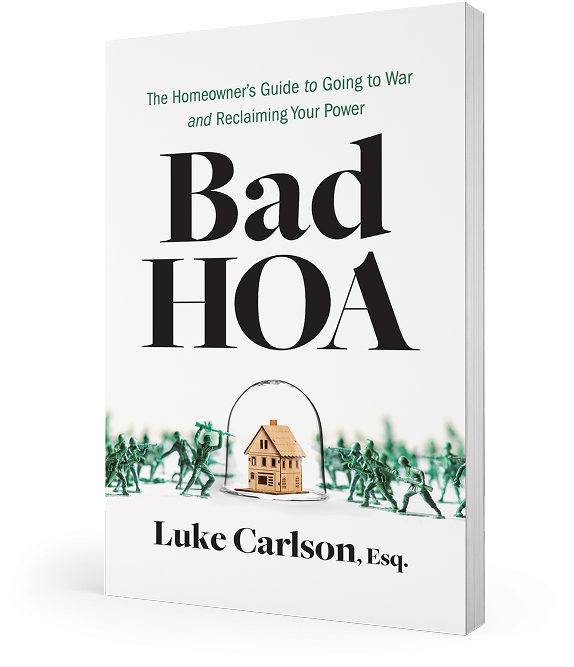
We Wrote The Book On Bad HOAs
…literally.
We didn’t just learn how to beat bad HOAs — we wrote the definitive guide to it.
After winning more of these fights than any firm in the country, we put the entire playbook
in print. When you hire us, you get the team that wrote it.
The firm bad HOAs across the country hope you never call.
★★★★★#1Best Selleron Amazon
Why LS Carlson Law
Why Homeowners Choose Us for Their HOA Dispute
Most homeowners don’t come to us over a simple disagreement. They come because something has gone wrong — rules enforced unevenly, authority exercised without accountability, a board that has stopped acting in the community’s best interest. We are not a general practice firm that occasionally handles HOA matters. We are America’s Largest Law Firm Fighting Bad HOAs.
California & Florida
Comprehensive knowledge of HOA laws and regulations, refined through thousands of cases across California and Florida.
America's Largest
Having handled more HOA disputes than any firm in the country, we recognize the recurring tactics boards use — from selective enforcement to procedural manipulation — and exactly how to counter them.
Deliberate Pressure
We identify leverage points, apply pressure deliberately, and position each matter for resolution or escalation based on your goals.
Every Forum
Proficiency across the full range of dispute resolution — pre-litigation strategy, negotiation, mediation, arbitration, and court intervention.
Trial-Ready
Full preparedness to take your case to court when necessary, ensuring strong representation at every stage of the fight.
Never Associations
We do not represent associations. Ever. Our experience, insight, and strategy are directed entirely toward protecting homeowners.
Held Accountable
A strong history of resolving HOA disputes in favor of homeowners — holding associations accountable when they cross the line.
01
California & Florida
Expertise in HOA Laws
Comprehensive knowledge of HOA laws and regulations, refined through thousands of cases across California and Florida.
What We Fight
Types of Disputes We Handle
When an HOA stops playing fair, these are the fights we take on — and win.
When you purchase into a common interest community, your Board works for you. The homeowners are the principals and the Board is the agent entrusted with protecting what is often your greatest financial asset: your home and the shared property that supports its value. Maintaining roofs, drainage systems, slopes, structural components, and common amenities is not a courtesy or administrative preference. It is a fiduciary mandate imposed by governing documents and community association law. The law demands that boards protect the common property through reasonable maintenance, proper investigation of reported problems, consultation with qualified professionals when necessary, and responsible planning through the association’s reserve study. That reserve study functions as the community’s financial roadmap for long-term maintenance. When a board ignores it, postpones necessary repairs, or dismisses expert recommendations, the decision is not financial prudence—it is a reckless gamble with homeowner equity. Importantly, this duty is non-delegable. Management companies may assist with operations, but the fiduciary responsibility to protect the property and the community’s financial stability remains squarely with the board.
When that responsibility is ignored, the consequences escalate quickly. Minor drainage problems turn into structural damage, roof leaks expand into interior losses, and slope instability becomes a safety hazard that threatens insurance coverage and property value. The legal question then becomes whether your Board honored the fiduciary standard of care required of those managing property on behalf of others. Homeowners are not passive observers in this process. You have the right to verify, not simply trust, how your association is managing your property. Governing documents and state law give you the power to inspect records such as maintenance bids, engineering reports, and reserve studies that reveal whether the board is protecting the community or gambling with it. When boards ignore known risks, delay repairs without justification, or conceal the financial reality of deteriorating infrastructure, homeowners can demand corrective action, call special meetings, replace directors who neglect their duties, and pursue legal remedies for breach of fiduciary duty when necessary. Community associations exist to serve their members. If your Board is gambling with the maintenance of the property that protects your investment, accountability is not optional—it is the mechanism homeowners use to take back control.
CC&Rs: The Homeowner’s Bill of Rights
The declaration of covenants, conditions, and restrictions (CC&Rs) is the binding constitutional contract of every community association. Recorded against the land and enforceable against every owner in the community, the CC&Rs operate as the homeowner’s bill of rights—a two-way street that binds the board just as strictly as it binds the homeowner. While boards often invoke the CC&Rs to regulate property use or collect assessments, the same document places strict limits on the board’s power, defines the association’s maintenance obligations, and establishes the fiduciary duties owed to the membership. Courts consistently treat the CC&Rs as the controlling authority in community association disputes, meaning boards cannot selectively enforce provisions that benefit the association while ignoring provisions that protect homeowners. Because CC&Rs function as enforceable contracts, many declarations also contain fee-shifting provisions that allow prevailing homeowners to recover attorney’s fees—an important legal mechanism that enables owners to hold associations accountable when boards exceed their authority.
When Boards Break the Governing Contract
Most CC&R disputes arise not because the governing documents are unclear, but because boards choose to apply them inconsistently. Selective enforcement, arbitrary architectural denials, retaliatory rule enforcement, and the quiet abandonment of maintenance obligations are not merely governance mistakes—they are breaches of the governing contract and violations of the board’s fiduciary duty to the community. Courts reviewing these disputes frequently evaluate whether the board acted arbitrarily and capriciously, whether similarly situated homeowners were treated differently, and whether the association enforced its rules with the consistency that a binding contract requires. Policy preferences, aesthetic judgments, or internal politics do not override the governing documents. The CC&Rs exist to limit power, require transparency, and protect every homeowner equally. When a board attempts to use those documents as instruments of control while disregarding the obligations they impose on the association itself, the CC&Rs become the homeowner’s primary tool for restoring accountability.
No HOA board is above the law. Federal civil rights protections such as the Fair Housing Act (FHA) and the Americans with Disabilities Act (ADA) apply fully inside community associations, and no provision in an HOA’s governing documents can override those protections. While boards exercise authority to manage the community, that authority is strictly limited by laws designed to protect where and how people live. Association authority ends where your civil rights begin. For homeowners, this means the board cannot use its enforcement power to impose rules that discriminate, exclude, or retaliate. Courts have repeatedly recognized that HOA governance must operate within the same civil rights framework that governs landlords, lenders, and other housing actors. When boards ignore those limits, they are not simply exercising discretion—they are engaging in governance overreach that exposes the association to serious legal liability.
Discrimination within an HOA rarely announces itself openly. More often, it appears disguised as “neutral enforcement” or procedural compliance. A board that denies a disability accommodation will often claim cost, precedent, or technical rule compliance rather than admit that federal law requires the accommodation. Yet the law is clear: reasonable accommodations are not favors a board may grant or deny at will—they are mandatory legal obligations. Courts and regulators look past the language of enforcement and instead examine patterns of conduct, including whether similarly situated homeowners were treated differently, whether rules are selectively applied, and whether enforcement intensifies after a homeowner asserts their rights. Red flags frequently include situations where an HOA: denies modifications necessary to accommodate a disability, restricts occupancy in ways that conflict with legally recognized family structures, refuses to recognize the housing rights of domestic partners, or enforces architectural and use restrictions in ways that disproportionately affect protected classes. Retaliation against a homeowner who raises a fair housing concern is not merely poor governance—it is a separate, actionable violation of federal law that can carry significant penalties. When a board crosses these lines, homeowners are not powerless. The law provides clear mechanisms to hold associations accountable, compel compliance, and ensure that community governance operates with the transparency, fairness, and respect for civil rights that the law demands.
High-density community living inevitably places homeowners in close proximity, but when a neighbor’s conduct damages property, creates persistent noise, causes water intrusion, or interferes with the quiet enjoyment of a home, the issue rarely remains just a dispute between two residents. In a community association, the CC&Rs function as a binding contractual framework designed to protect homeowners and preserve property values. When a board receives notice that a neighbor is violating those rules and fails to act, the association is no longer a neutral observer. Selective enforcement, favoritism, or simple inaction can transform a neighbor problem into a governance failure, because ignoring clear violations that harm another owner can amount to a breach of the association’s contractual obligations and a breach of fiduciary duty owed to the community.
The Board’s Fiduciary Trap and the Path to Resolution
Boards often attempt to shield inaction behind the “business judgment rule,” but discretion is not a license to abdicate responsibility. While boards have authority to exercise reasonable judgment in enforcing rules, they do not have the right to ignore documented violations that threaten a homeowner’s property, finances, or quiet enjoyment. When a board knowingly fails to enforce its governing documents, homeowners may have legal recourse to hold both the offending neighbor and the negligent board accountable. Homeowners facing these situations should move beyond informal complaints and begin documenting violations, demanding enforcement, and invoking formal processes such as Internal Dispute Resolution or a meet-and-confer with the board. Transparency and accountability are not optional principles in community governance; they are the mechanisms that ensure the rules protecting homeowners are actually enforced.
Common areas are not a peripheral feature of community association life—they are the shared assets homeowners collectively own and the board is legally obligated to protect. When a board fails to maintain those assets, it is not simply poor management. It is a breach of duty to the very people whose assessments fund the community. In a planned development, greenbelts, pools, and clubhouses are not decorative amenities. They are capital assets purchased and maintained with homeowner money, and their neglect can erode property values across the entire community. In condominium and stacked-structure communities, the stakes are even higher. The association typically controls the building envelope itself: roofs, exterior walls, shared plumbing systems, electrical infrastructure, hallways, and parking structures. These are the systems that keep units dry, structurally sound, and habitable. When they fail, the consequences are immediate and costly. Water intrusion can trigger mold, deferred structural repairs can accelerate building deterioration, and neglected infrastructure can lead to massive special assessments that fall directly on homeowners. Even so-called exclusive use common areas do not change the equation. A patio, balcony, or parking space may be reserved for one owner’s use, but it often remains the association’s maintenance responsibility. Boards cannot hide behind the label “exclusive use” to avoid obligations the governing documents place squarely on them.
These disputes are rarely random. They follow a familiar pattern of board inaction: roofs left unrepaired after leaks are reported, structural components ignored despite reserve study warnings, or encroachments onto common property tolerated until shared space is effectively lost. The moment the board receives notice of a problem, the legal landscape changes. At that point, the board loses the ability to claim ignorance and must act to protect the community’s property. If it does nothing while damage spreads, the association becomes legally and financially responsible for the consequences of that inaction. Courts evaluating these cases examine whether the board knew about the problem, whether it responded appropriately, and whether the governing documents clearly assign the duty of repair to the association. For homeowners, those governing documents are not abstract rules. They are the roadmap of accountability. They define exactly where the board’s obligations begin and where its excuses end. Because common areas belong to the membership collectively, neglect of those assets harms every owner at once. A leaking roof, deteriorating parking structure, or mismanaged infrastructure is not merely a maintenance issue. It is a direct threat to the value, safety, and financial stability of every homeowner in the community.
A community association board’s power is strictly conditional, not absolute. It exists only because the governing documents—the CC&Rs, bylaws, and rules—create a binding contractual framework between the association and every homeowner in the community. Those documents are not merely tools the board uses to regulate residents; they are also the homeowner’s contractual shield against board overreach. The board must follow them just as rigorously as the homeowners it governs. When a board enforces rules inconsistently, grants preferential treatment to some members while targeting others, or allows personal relationships to influence enforcement decisions, it is no longer exercising legitimate authority—it is breaching its fiduciary duty to the community. The law requires uniform application of the rules, equal treatment of similarly situated homeowners, and enforcement decisions grounded in legitimate community standards rather than personal preferences or social power.
Patterns of Abuse and the Legal Threshold
Selective enforcement rarely appears as a single isolated decision. Instead, it reveals itself through patterns of unequal treatment that undermine the contractual foundation of the association. Red flags frequently include:
Approving an architectural application for one homeowner while denying a materially identical request from another
Aggressively enforcing rules against a vocal critic while ignoring the same violation elsewhere in the community
Granting board members or favored allies privileges the association formally denies to the general membership
When these patterns emerge, the law demands a legitimate, neutral explanation for the disparity. If the board cannot provide one, the conduct becomes legally indefensible because it violates the fundamental requirement of consistent rule enforcement. Courts routinely recognize that a documented pattern of disparate treatment calls into question the integrity of the board’s governance itself. And when a board abandons the fair and uniform enforcement required by its governing documents, it risks forfeiting the protection of the Business Judgment Rule, exposing its decisions—and potentially its leadership—to direct legal challenge.
Negligence is one of the legal tools homeowners use to hold HOA boards accountable when they ignore problems that threaten the community’s property and safety. Once a board is notified of a dangerous condition—such as a failing roof, deteriorating walkway, or defective drainage system—the clock begins ticking. The board is not merely managing a neighborhood; it is exercising fiduciary authority over assets that belong collectively to the homeowners. When that authority is met with delay, indifference, or poor judgment, the law treats it as a breach of duty. The consequences are not theoretical. Water intrusion that spreads through a home, mold that invades living space, or structural damage that erodes property value is not just “property damage.” It is a direct intrusion into the sanctuary of a homeowner’s most important financial asset. A board that waits for a crisis to act is a board that has already failed the community it was elected to serve.
Most negligence disputes in HOA communities follow the same pattern: the association or a neighboring owner knew about a problem, had the power to fix it, and chose not to act within a reasonable time. Courts analyzing these cases focus on three simple questions: what did the responsible party know, when did they know it, and what did they do about it? A reported roof leak left unresolved while water spreads through a homeowner’s interior, a drainage system ignored until flooding occurs, or a balcony that repeatedly spills water into the unit below are not minor maintenance issues—they are failures of governance. When boards disregard known risks, they do more than invite repair costs. Their inaction can trigger liability for the full scope of harm caused by the delay, including consequential losses that grow precisely because the problem was allowed to worsen. Governing documents are a contract with the homeowners, not a shield for the board. When the board ignores that contract, the law allows homeowners to demand accountability.
Your Board of Directors has no inherent power. Its authority exists solely by the consent of the governed—the homeowners. That consent is expressed through fair, transparent elections. When that process is manipulated, it is not a technical defect—it is a violation of homeowner rights. A board seated through manipulation is a board without standing. When the ballot box is compromised, the board’s entire platform—every rule it enforces, every assessment it collects, every dollar it spends—is built on sand. In practical terms, that means your money, your property rights, and your peace of mind are being controlled by an illegitimate authority. Election fraud in an HOA is not a procedural issue—it is governance corruption and a breach of the fiduciary duty owed to the very homeowners the board is supposed to serve.
The reality is that the fox is often guarding the henhouse. Those with the most to gain from a rigged election—incumbent directors and their allies—are frequently the same individuals controlling voter rolls, ballots, and communication channels. This misconduct often appears in identifiable patterns: voter purging, where certain homeowners are quietly removed from eligibility lists; phantom voting, where unqualified individuals are inserted to influence the outcome; and information blackouts, where critical election details are selectively withheld to protect those in power. The law does not tolerate this kind of procedural theater. Courts look beyond surface compliance to determine whether the election met the standards of transparency, neutrality, and fairness that you are entitled to by right. You are not a spectator in your own community. If your election has been compromised, every subsequent board action is subject to challenge, and you have the legal right to demand accountability and take your community back.
A homeowner’s right to install solar energy on their own property is protected by law, and HOA governing documents cannot simply override that protection. While associations may impose reasonable restrictions on how a system is installed, they cannot use architectural control as a tool to block solar altogether. The law is clear: a board’s taste in rooflines, panel placement, or community aesthetics cannot defeat a homeowner’s right to generate energy from their own property. In many states, including those with Solar Rights Acts, a restriction becomes legally unreasonable if it significantly increases the cost of the system or materially decreases its efficiency—often measured by thresholds such as the common “10/10” or “20/20” rules. When boards impose conditions that function as an effective prohibition—such as requiring placement that eliminates energy production, imposing excessive review fees, or delaying approval through endless architectural demands—they are not regulating installation; they are undermining a statutory right.
Red Flags of Illegal Solar Rejection often include disparate treatment compared to other exterior modifications, mandatory “hidden” placement that destroys system efficiency, excessive consulting or review fees, and approval delays that appear designed to wear the homeowner down. These tactics frequently reflect discretionary gatekeeping rather than legitimate architectural review. When an HOA ignores the legal limits placed on solar regulation, the issue is no longer aesthetics—it becomes governance overreach and a potential breach of fiduciary duty to the community. Homeowners confronting these situations are often in a stronger legal position than they realize, because solar protection laws were designed precisely to prevent associations from using aesthetics as a weapon against property rights. When boards cross that line, homeowners have the right to hold them accountable and enforce the principle that objective legal standards—not subjective architectural preferences—govern the outcome.
How We Win
Our Proven Approach to Your HOA Dispute
A Bad HOATM won’t back down on its own. From your first call to final resolution, every case runs the same disciplined playbook — built to win.
A Bad HOATM won’t back down on its own. Here’s exactly how we take your case — and win it.
When you book a consultation with LS Carlson Law, you can expect a focused, strategic discussion about your dispute. Your attorney will review the key facts, look at any relevant documents you provide, and spend the bulk of the consultation digging into the details with you.
The goal is simple: to help you understand where you stand, what rights you may have, and what options are available. Depending on your situation, that may include negotiation, formal legal action, litigation, or practical self-help remedies that may apply.
By the end of the consultation, you should have a clearer understanding of your position, the strengths and challenges of your case, and the best path forward.
Once you retain LS Carlson Law, you are no longer facing the HOA alone. We send a formal Notice of Representation to your association, putting them on notice that you are represented by counsel and that communication should now go through our office.
This is often the first major shift in the dispute. Instead of trying to respond to confusing letters, board pressure, threats, delays, or stonewalling on your own, you now have a legal team between you and the association.
From that point forward, we take the wheel, develop the strategy, manage the communication, and begin moving your matter toward resolution.
Every HOA dispute is different, so the path to resolution depends on the facts, the governing documents, the association’s conduct, and the leverage available. In some cases, the right move is a strong legal demand. In others, it may be informal negotiation, mediation, arbitration, or litigation.
Whatever the path, the objective remains the same: to bring your dispute to a swift, effective, and meaningful resolution.
LS Carlson Law advocates with purpose, pressure, and precision — working to protect your rights, restore your peace of mind, and help you move forward.
Homeowners Ask. We Answer.
Frequently Asked Questions
Eight straight answers — from the only firm of its size that never represents associations, boards, or management companies.
Yes, under California's Davis-Stirling Act (Civil Code § 5975(c)), the prevailing party is entitled to reasonable attorney's fees. Courts determine reasonableness, and alternative dispute resolution must be attempted first.
Expect a focused discussion about your case with a review of documents and deep dive into details, outlining your legal options including litigation, negotiation, or self-help remedies.
No, LS Carlson Law operates on an hourly basis to ensure every dollar goes toward winning the case. Contingency doesn't suit most HOA disputes since they're not about big payouts but protecting rights.
It depends on your situation. A well-crafted demand letter may prompt the HOA to back down, but stronger action may be necessary for aggressive or unresponsive HOAs.
Over 20 years fighting and winning against HOAs — more success than any other firm in the U.S. The founder authored "Bad HOA™" and pioneered many legal strategies homeowners now use.
Clients experience unmatched legal representation with strategic, aggressive, and results-driven representation. Clear communication ensures clients always know where their case stands.
Technically yes, but it is extremely difficult and not realistic in practice. Homeowners should think carefully and consult an HOA attorney before attempting.
Review your governing documents to understand the violation and proper enforcement process. Challenge the notice if it is unclear, selective, or baseless by remaining calm and fact-based in communication.
◆VERIFIED ON GOOGLE · YELP · AVVO · FACEBOOK · YELLOW PAGES · BBB
JT
★★★★★ —1 day ago
Google
Jeffrey Kominsky, Andrea, Lillie, and the rest of the awesome team at LS Carlson Law have helped me navigate some very difficult subjects. I will be returning to this law firm for any HOA or real estate issues that may occur in the future. Thank you!!
Rosanne Dimattina
★★★★★ —3 days ago
Google
Our recent consultation with Jocelyn N. Chidsey, Esq., of LS Carlson Law was exceptional. We were very impressed that she had obviously reviewed all of the information we had sent prior to the consultation. Her professionalism, knowledge of the subject matter and recommendations were extremely helpful. She took the time to answer all our questions completely and we came away from the consultation with the feeling that all of our concerns had been addressed fully. I would highly recommend Jocely Chidsey and would plan on using her services in the future if the need arises.
Lisa Kervin
★★★★★ —2 weeks ago
Google
Daniela Tolliver was professional and efficient! She listens and responds with excellent wisdom. Highly recommend!!
Gordon Dressler
★★★★★ —2 weeks ago
Google
Based on very positive Web reviews, I contracted with LS Carlson Law mid-2026 for legal representation in an Alternative Dispute Resolution mediation hearing related to breach-of-contract by my homeowner association. I obtained the services of attorneys Vasko Alexander and Richard Canada at LS Carlson Law. These gentleman provided exemplary legal representation for me. Based on my experience, I can state they are extremely knowledgeable of the relevant laws/statutes governing homeowner associations, were careful to understand my statements and supporting documents as to the facts of this matter, stayed in constant communication, provided to me an objective and thorough merits-of-your-case review early on, and prepared and presented an excellent brief to the mediator at time of our mediation hearing. I highly recommend LS Carlson Law and these attorneys, as well as their supporting staff of paralegals, as the "go to" law firm for representation, even just consultations, in any disputes one might have with homeowner associations.
Leonard Bay
★★★★★ —3 weeks ago
Google
I reached out to LS Carlson Law for help with a dispute involving my HOA, and the experience was outstanding from the first call. The firm is professional, organized, and clearly knows this area of law inside and out. They focus on representing homeowners against HOAs, and that specialization shows in how quickly they understood my situation and laid out my options.
I consulted with attorney Michele Hobby, and she was exceptional. She listened carefully, asked the right questions, and explained where I stood in plain language without any pressure or legal jargon. She was honest about the strengths and weaknesses of my position, which gave me real confidence in her advice. I left the conversation with a clear understanding of my rights and a practical path forward.
Michele is an excellent ambassador for LS Carlson Law. Her knowledge, responsiveness, and genuine concern for homeowners reflect a firm that takes its clients seriously. If you are dealing with an HOA that is overstepping, I highly recommend giving them a call.
Leonard B.
★★★★★ —3 weeks ago
Yelp
Dealing with my HOA had become stressful enough that I finally decided to talk to a lawyer, and I'm glad I called LS Carlson Law. This is a firm that represents homeowners against HOAs, and you can tell right away that this is what they do every day. The intake process was smooth, everyone I dealt with was courteous and prompt, and I never felt like just another file.
My consultation was with Michele Hobby, and she was fantastic. She had clearly reviewed my situation before we spoke, she asked sharp questions, and she walked me through my options in plain English. What I appreciated most was her candor. She told me what was realistic and what wasn't, with no sales pitch and no pressure. The consultation was well worth it, and she was clear and upfront about what each option would cost, so I could weigh my choices without worrying about surprises later. I came away understanding my rights far better than I did going in, along with a clear sense of what to do next.
Michele represents LS Carlson Law extremely well. If she is any indication of the caliber of people at this firm, homeowners are in very good hands. Highly recommended for anyone whose HOA is overstepping.
John Lamp
★★★★★ —3 weeks ago
Google
Keith Lehman and Kevin Hirsh of LS Carlson Law represented me against an HOA complaint. Their deep knowledge in HOA practices very quickly put the HOA on defense and the matter was settled in a relatively short amount of time. I have had a few expierences in business litigation and firmly believe in hiring the best in the practice area. LS Carlson Law has carved out a very special expertise in representing Home Owners against HOA's.
Sydney Hampton
★★★★★ —3 weeks ago
Google
We worked with Steven Shack for an ARC matter - special enforcement and our HOA was attempting to apply rules not according to our HOA guidelines. Mr. Shack ultimately helped us obtain our approval letter.
Andy Schmiedel
★★★★★ —3 weeks ago
Google
Jeff Kominsky was amazing. He was prepared for our zoom call and very patient answering my questions.
Robert Cullen
★★★★★ —0 months ago
Google
Jeff Kominsky with LS Carlson Law was absolutely fantastic in helping us with our legal situation. He came highly recommended by another attorney (who my wife and I know), and Jeff could not have been more helpful, knowledgeable, and professional. Five-star service all around. Highly, highly recommend.
J
James T.
★★★★★ —0 months ago
BBBBBB
Our family was dealing with an extremely complicated HOA situation involving selective enforcement, an architectural dispute, water intrusion issues, harassment, and problems involving a neighbor. By the time we looked for legal representation, the situation had become exhausting and overwhelming. We spoke with three different law firms before choosing LS Carlson Law. Another attorney who did not handle this type of work referred us directly to Luke Carlson and told us this was the firm we wanted handling a dispute like ours. That referral carried tremendous weight. Their 20 plus years in business also mattered a great deal to me. When you are dealing with something this serious, experience matters. From the first consultation, their strategy was clearly explained. They were transparent, honest, realistic, and incredibly knowledgeable. We never felt like they were overpromising or simply telling us what we wanted to hear. The entire team was exceptional, from client intake to the attorneys handling our case. Everyone was responsive, professional, and genuinely helpful. We always felt that our case mattered and that we had a strong team behind us. Leading up to mediation, LS Carlson Law was tough and strategic with the other side. This mattered! Because of confidentiality, I cannot discuss the specifics, but I can say that the result exceeded what we had originally been seeking. After carrying the stress ourselves for so long, it felt like we could finally hand the battle to people who knew exactly what they were doing. They fought hard for us, were prepared and strategic, and gave us confidence during an incredibly difficult time. After going through the process personally, what stands out most is how well they represented our family. If you are a homeowner dealing with a serious or overwhelming HOA dispute, I would absolutely recommend LS Carlson Law. We are incredibly grateful for what they did for our family and would recommend them without hesitation.
Wanda M.
★★★★★ —1 month ago
Yelp
Intake representative and client service specialist at LS Carlson Law - Mr. Willie Lark was our first person of contact with LS Carlson Law. Willie took the time to read our "detailed" statement that we submitted online via the website page /"tell us about your matter -contact us". His interpersonal and customer-service skills were a 5 star rating - He listened to our concern/s and he explained "what happens next". Therefore our early expectations of "the process" of what we must do and what happens next, had us better prepared for our upcoming consultation - scheduled on the same week!
florida monarch
★★★★★ —1 month ago
Google
I was lucky enough to do an intake evaluation with Jeff Kominsky. My case has acquired a ton of complexity, and Jeff was able to hang in there with all of the ridiculous legal details. My situation ended up not being the right fit for his firm, but he treated me with kindness and respect and still gave me a lot of practical guidance on how to think through my options. Definitely an hour well spent!
florida monarch
★★★★★ —1 month ago
Google
Nothing about a lawsuit is good, but the staff here - including, and especially, Kitty Nix! - really made this intake process a lot more pleasant. Being smart and kind is wonderful in any industry, but when you're dealing with the complexity of legal problems and the personal difficulties that come with it, it's a gift to have good people on your side. Thank you to the whole office! Every person has been wonderful - you all are genuinely the best.
Adelaida Torres
★★★★★ —1 month ago
Google
Excellent and Honest Advice! I recently consulted with this law firm regarding a difficult condominium/HOA matter, and I was extremely impressed by Michele Hobby. She was professional, objective, and very honest in her assessment of my situation. What I appreciated most was that she did not simply tell me what I wanted to hear or encourage me to pursue unnecessary legal action. Instead, she carefully explained my rights, helped me understand the situation from a practical perspective, and recommended what she believed was the best course of action for me at this time. Her advice gave me clarity and, most importantly, helped me avoid potentially unnecessary legal expenses. She also offered to continue assisting me if the situation develops or if I needed further legal help in the near future. Trust me I will!!
I truly appreciated her professionalism, honesty, and willingness to put my best interests first. I highly recommend this firm to anyone looking for knowledgeable, objective, and trustworthy legal advice.
And last, thank you to all the persons I talked on the phone before my interview, all of them were professional and very attentive for what I am extremely grateful!!
Julia
★★★★★ —1 month ago
Yelp
I had a consultation with Jeff Kominsky. He was very knowledgeable and compassionate. I just signed my retainer with them and am hoping my situation with my HOA gets resolved. I'll post an update. So far so good!
Michael LaBastille
★★★★★ —1 month ago
Google
We had a great consultation. Daniela was very clear and concise with the information she provided, which helped me very much in making my decision.
Lance S.
★★★★★ —1 month ago
Yelp
Rated 5 stars — no comment left.
Jane Kenneally
★★★★★ —1 month ago
Google
I had a consultation with Attorney Daniela Tolliver, from the very start she was incredibly professional yet completely relatable, which instantly put me at ease. She took the time to truly listen to my situation and provided clear informative guidance. The entire session was efficient and highly useful, giving me solid understanding of my next steps. I am deeply grateful for her kindness and expertise. I highly recommend her services to anyone looking for a knowledgeable and compassionate Attorney. Jane K.
Abdiel T.
★★★★★ —2 months ago
Yelp
Despite not being the right fit, Kitty made sure I still felt like part of the family. A true professional and genuinely kind and compassionate throughout an unexpectedly enjoyable conversation. If speaking with Kitty is the worst case scenario when calling this firm, I'd be looking forward to the worst each day
Danielle Killian
★★★★★ —2 months ago
Google
What an incredible firm and amazing team! As I've engaged with Chris, Willie and others, they've shown extraordinary care and integrity in their dealings with me.
Beyond my own engagement, the resources the firm and team proactively provide illustrate a clear mission-driven approach. They can be useful to HOA members and property managers, as well as board members aiming to do right by their neighbors.
My hope is policy makers, insurance companies, and lenders will also take note. LS Carlson's work illustrates a need for HOA oversight mechanisms, as well as grant funding and incentives on par with those provided to renters, single-family and multifamily building owners. The potential ROI for leaning in to solve the problems illustrated by their work include improved housing stability, housing stock conditions, and affordability.
Really grateful LS Carlson Law.
Colleen Wilkinson
★★★★★ —2 months ago
Google
I can not say enough how grateful I am for Michelle Hobby.. She took my very stressful situation and provided me with the empathy, sympathy and extreme knowledge of the FL HOA laws as she worked my case.. I highly recommend her as she's very professional and hard working. She was great!
Paula Hoffman
★★★★★ —2 months ago
Google
I first contacted Jeff Kominsky and he directed me to Ben Harding here in Florida. They did a GREAT job of defending me against an unlawful HOA. I was given an apology and compensation because of their actions and their knowledge of HOA or in my case COA Law. I cannot thank them enough!
Paula H.
★★★★★ —2 months ago
Yelp
Rated 5 stars — no comment left.
Susan Efe
★★★★★ —2 months ago
Google
Daniela was EXCELLENT!!!!!! Listening to my long winded rant of my situation ----- She needs an award for patience! Also she was very informative and explained everything really well. A really good first consultation.
Heather McClymont
★★★★★ —2 months ago
Google
Rated 5 stars — no comment left.
Anne Gilbertson Kraemer
★★★★★ —2 months ago
Google
Attorney Vasko Alexander was extremely helpful in preparing us for our small claims court against our HOA. His expert advice and role playing with me as to how to answer the judges questions made such a difference. We won our case and it is thanks to Vasko Alexander.
Rosangel Acosta
★★★★★ —2 months ago
Google
Jeff Kominsky was extremely professional, compassionate, and highly knowledgeable. He understood my case very efficiently and clearly, and I felt very reassured after his explanations. Thanks to his guidance, I now have a much clearer understanding of my case.
Seth
★★★★★ —2 months ago
Google
I am so glad I had the consultation with Scott McDonald at LS Carlson. I had a consultation with another firm that went no where. I had recieved no advice or thoughtful plan. Though the attorney was nice, he had not done any preparation even though I included documents and a timeline. Scott was the opposite. He showed up prepared, had a great grasp for the situation and cared about what was in my best financial / emotional interest (I think we can all agree that a dispute with your HOA will take a lot out of you). I would recommend Scott McDonald in a heartbeat and consider hiring him when the timing is right. I really did not want to do a second consultation. But I am thankful that my instinct told me to it with LS Carlson
B K.
★★★★★ —2 months ago
Yelp
I talked to Kitty w/ questions about a case. Very helpful, very professional. She really took the time to listen to the details and ask all the right questions.
Mel
★★★★★ —2 months ago
Google
Excellent professional service. We had a neighbor/ HOA dispute, which was interfering in our rights as home owners. Both attorneys Michele Hobby and David Lehr, expertly navigated us through the process, were empathetic to our situation, and expertly addressed the matter. With their representation the matter was successfully handled, and our rights restored, much to our satisfaction. Highly recommended.
Jose Munoz
★★★★★ —2 months ago
Google
Ms. Tolliver was very professional and was able to address most (95%) of all the questions, due to time constrain. With her guidance we are moving forward with our situation.
Tam Nguyen
★★★★★ —2 months ago
Google
LS Carlson Law was incredibly responsive, contacting me soon after I reached out for representation. Their intake and scheduling staff were top-notch and made the process seamless. My consultation with Vasko regarding my HOA issues was fantastic. He was level-headed, educational, and a strong advocate for me, while remaining entirely realistic about the most likely outcomes and expected costs. Dealing with HOA issues is stressful, but Vasko's honest, grounded approach gave me complete clarity. Highly recommend!
Thakurdai Ardjoensing
★★★★★ —2 months ago
Google
Rated 5 stars — no comment left.
Virginia Romano
★★★★★ —2 months ago
Google
I had a very positive experience working with LS Carlson Law. The team was professional, responsive, and took the time to explain my legal options clearly throughout the process. They advocated for my interests and provided thoughtful guidance regarding my HOA dispute and California Civil Rights Department complaint.
I especially appreciated their communication, knowledge, and dedication to helping me understand my rights. I would recommend LS Carlson Law to anyone seeking experienced legal representation in HOA and homeowner-related matters.
Thank you to the entire team for your assistance and professionalism.
Leon Brown
★★★★★ —2 months ago
Google
We had a wonderful experience speaking with your attorney, Scott McDonald. He eased our mind without going to any particular outcome. We feel assured that we’re in the right hands and appreciate your professionalism, courtesy and kindness.
Carole Hutchins
★★★★★ —2 months ago
Google
If you're looking for an attorney who is knowledgeable, relentless, and genuinely cares about his clients, I cannot recommend Steven Shack and his team highly enough. Steven is representing me in a dispute against my HOA, and from day one he has demonstrated exceptional professionalism, legal expertise, and unwavering dedication. He leaves no stone unturned, is incredibly thorough, and fights tirelessly to protect his clients' interests. Throughout the process, he has been responsive, honest, strategic, and has taken the time to ensure I understand every step. What truly sets Steven apart is that he genuinely cares about the people he represents. You are never treated like just another case. His entire team is professional, courteous, and committed to delivering outstanding service and results. Having an attorney you can trust during a challenging legal matter is invaluable, and I have complete confidence in Steven Shack and his team. If you need a lawyer who combines exceptional legal talent with integrity, compassion, and determination, I wholeheartedly recommend them. Five stars isn't enough.
Richmond Kelly
★★★★★ —2 months ago
Google
This afternoon I had the pleasure of consulting with Daniela Tolliver, Esq. of the LS Carlson Law firm. Ms. Tolliver is extremely well versed in HOA law and the various options that could be available. I am quite certain that my wife and I will retain The LS Carlson Law firm as long as Ms. Tolliver is on our team!
Paul Martinelli
★★★★★ —3 months ago
Google
After being bullied by my HOA I had had enough and am grateful for the help of LS Carlson lead by Jeff Kominsky and Christine Lowe. They understood the law, and leveraged every option I had. It's amazing at how fast the tune changed from my HOA when they realized I had this level of quality representation. My only regret is I didn't seek their help sooner.
Vera Ramone King
★★★★★ —3 months ago
Google
LS Carlson Law is hands down the Best law firm in south Florida. From my initial consultation with Michelle Hobby to now I am so impressed with her and the team with their professionalism, knowledge of the HOA laws and their hard work ethics are by far very most impressive. They don't waste a minute getting to work and I am at ease knowing I'm in good hands. I highly recommend this firm because they get the job DONE! If you want to WIN your case..... Go with a WINNER law firm!!
Chris Rohrbach
★★★★★ —3 months ago
Google
Michelle Hobby was great answered all my questions that I asked. Thank you!
Denise Case
★★★★★ —3 months ago
Google
Daniela was very professional and answered all my questions during the consultation.
Hubert Dumas
★★★★★ —3 months ago
Google
My initial intervue with Kevin was extremely informative and educational. I feel much better having chosen this law firm. His knowledge of this part of the law was spot on and I look forward to working with LS Carlson Law.
Cristina Gonzalez
★★★★★ —3 months ago
Google
Joselyn Chidsey was very ethical and helpful. I thought she was very well prepared for the consultation and she gave me helpful strategies to solve my HOA dispute in a short amount of time. I also appreciate very much the free homeowner empowerment kit that this firm provides on Reddit. This kit helped me to prepare for this meeting and get a good understanding from it. I also appreciate all the information in the Bad HOA podcast and YouTube videos that this firm provides. I highly recommend a consultation with them.
David Katz
★★★★★ —3 months ago
Google
I spoke with Mr. Jeff regarding a condominium matter. It was immediately clear that he has extensive knowledge of condominium law and significant experience in this area.
As a homeowner navigating the current crazy condo world, I appreciated his willingness to listen, provide straightforward guidance, and help me understand my options.
It reassuring to speak with someone who clearly understands the clients needs. I look forward to continuing to work with Jeff as this matter moves forward.
Ellen F
★★★★★ —4 months ago
Google
Very strong skills and very easy to work with
Angela Chung
★★★★★ —4 months ago
Google
I had a consultation with Tate Casey. I consulted him for legal advice about my HOA board breaching our governing documents and other things. He gave me clear directions on what I should do next and explained that I should only take legal action if it's my only choice. He was eager to help me in my situation. I would choose to work with him if my issue doesn't resolve on its own.
Zach Ingram
★★★★★ —4 months ago
Google
Daniela was well informed and prepared for our call. I look forward to working with the LS Carlson Team.
joseph grosso
★★★★★ —5 months ago
Google
While searching for Attorneys to assist us, after several consultations, nothing was clicking.....we found out they also defend HOA's. NOT the case with LS Carlson. They only defend residents. Our case was different in regard that our HOA was not going after us for any violations, WE were questioning our HOA, our BOARD, their employees, as well as the Management Company. Our financials were not adding up. Reckless overspending, budgets not being adhered too, no accountability. Which lead to dues being increased. Our Attorney, Ahmet Brown along with Jeff Kominsky, Managing Partner, could not have been more supportive, professional, and just decent guys. With their constant guidance, some perseverance, we accomplished bringing in an entirely new Board, new employees as well as a new Management Company. This firm will give YOU, the power to fight back and take back your Village, take back your home. Never surrender your common sense. Where there is fire, there is smoke. One more note, Luke Carlson, who put together this wonderful firm has written a book entitled "Bad HOA." We guarantee you will find yourself saying over and over, "this is my HOA."
Joe & Barbara G. from Orlando
Jennifer Rosales
★★★★★ —5 months ago
Google
From the moment I spoke with Daniela Tolliver at LS Carlson Law, I immediately felt a sense of relief. I had been extremely stressed and overwhelmed dealing with my HOA situation, but Daniela was professional, attentive, knowledgeable, and genuinely compassionate throughout the conversation. She took the time to really listen, answered my questions clearly, and made me feel like my concerns actually mattered.
What stood out most was how confident and reassuring she was without making me feel dismissed or rushed. After speaking with her, I finally felt like I had someone in my corner who understood the situation and was willing to help. That peace of mind alone meant a lot to me. I highly recommend Daniela Tolliver and LS Carlson Law to anyone dealing with HOA or property-related issues.
Jane
★★★★★ —5 months ago
Google
My meeting with Chris Q was very nice. He was patient with me. Chris went over my options. I felt that he will be able to help me with my HOA and get the necessary repairs to my condo.
Kristine Miller
★★★★★ —5 months ago
Google
I look forward to working with Kevin Hirsh and the law firm. The first meeting went very well and I hope for smooth and quick outcome.
Michael Chen
★★★★★ —5 months ago
Google
My consultation with Ryan Davies was pleasant and enlightening. He provided a simple and upfront legal analysis of my case that allowed me to understand what the strengths and weaknesses of my case were...I appreciate Ryan [Davies], Kitty Nix, and all the staff at LS Carlson!
Kathy Allen
★★★★★ —5 months ago
Google
Very professional & knowledge.
Aggressively working toward a positive outcome.
Sean Hoppe
★★★★★ —5 months ago
Google
David and Benjamin guided us thru the process from start-to-finish. When it came time to make strategic decisions they provided a cost-benefit analysis based on their deep knowledge of the law. I think they know Florida Statute 720 laws better than the legislators who wrote the law.
null null
★★★★★ —6 months ago
Google
Scott put me at ease straight away, his sincerity was very noticeable, very informative and I came away very knowledgeable about the HOA world. His advice was taken with gratitude. Sylvia Allen
Bianca Merchant
★★★★★ —6 months ago
Google
LS Carlson Law handled a solar panel install approval and records request with my HOA in Tampa, FL. Our team at LS Carlson Law included Keith Lehman and Kevin Hirsh. They were amazing. No games, no BS, no surprise costs, just good work. I strongly recommend them to anyone with any HOA challenge really; I will go back to LS Carlson Law and request Keith and Kevin if I need the services again. They were professional, knowledgeable, creative, proactive. They moved efficiently while still ensuring that I understood the situation.
Jessica Cassidy
★★★★★ —7 months ago
Google
Jeff Kominsky is great. He is extremely sympathetic, professional, highly informative and cares about homeowners. He presents great paths to help homeowners in bad situations with deep knowledge and is very transparent about pathways forward and options. He’s very personable, and when looking to retain a lawyer, that definitely matters. I highly recommend him! Thank you, Jeff!
Cindy Carone
★★★★★ —7 months ago
Google
LS Carlson Law, especially Kelli M. Brown and associates were fantastic in guiding us through a major transition. Although, we were initially moving forward with an ADR, we never needed to initiate it. Kelli answered every question as we stopped a special assessment, dissolved our board and switched management and financial companies. Her professionalism and expertise helped us accomplish our goals. Highly recommend.
THANK YOU!!!!
Drew Fator
★★★★★ —7 months ago
Google
Steven Shack and Allegra Knopf did a great job handling my case. I would definitely use them again.
Bonnie Lawston
★★★★★ —7 months ago
Google
Excellent attorney and team. I would not use anyone else. Jeffrey listened to my concerns and offered a path forward while expressing empathy for our position. He is an extremely talented and expert in his field.
Carol C.
★★★★★ —7 months ago
Yelp
I highly recommend this firm. I had been dealing with an HOA issue for over a year, and once we hired LS Carlson Law Firm, the process became smooth and stress-free.
My attorneys, Keith Lehman and Daniela Tolliver, were professional, warm, and truly dedicated to achieving a quick, peaceful, and fair settlement.
Keith, Daniela, Emely, and Patti--thank you all so much for everything!
Sayeh Beheshti
★★★★★ —8 months ago
Google
Five-stars
LEO BURGHOFFER
★★★★★ —8 months ago
Google
Michele Hobby was knowledgeable and personable and had done her homework for our consultation.
Robert DiCaprio
★★★★★ —8 months ago
Google
LS Carlson Law combines knowledge of HOA/Condo law, with top notch customer service. My first phone encounter was with Andrew Thomas, who is one of the staff that handles initial inquiries. He was empathetic, knowledgeable, and listened to my concerns. He setup my appointment with Attorney Jeff Kominski, and made sure I was prepared.
Mr. Kominski was excellent. He is knowledgeable in condo law, and asked my wife and I a lot of questions regarding our concerns. Like Andrew, he was empathetic and listened to us. We are weighing our options regarding Mr. Kominski's legal suggestions, and if we decide to move forward, I will be glad to have him on our side.
rlchard heese
★★★★★ —8 months ago
Google
I'm a new client to LS Carlson Law, so the first person I talked to was Willie Lark. I have to say he is very calm and educated, when I'm trying to explain why I need the Law offices help. He explains the procedure and time line in such a way that I feel confident that I'm making the right choice. He me all the paperwork in a timely manner and said if I had questions to contact him, and I had questions, and he answered them...Thank you Willie
Steve Faghih
★★★★★ —8 months ago
Google
Superb customer service, excellent negotiation.
Ron S
★★★★★ —8 months ago
Google
Today I had a consultation with Jeff Kominsky to discuss an unpleasant encounter with a board member of my HOA.
I wanted to know what my legal options are in seeking punishment and removal of this man from our board.
Jeff is very knowledgeable concerning state statutes and gave me his impartial opinion on my being able to achieve my goals.
After listening to his feedback I reached a decision not to pursue any legal action.
Jeff was very helpful to me in making a rational conclusion.
Lilianne Pramanik
★★★★★ —8 months ago
Google
Jeff Kominsky's consultation with me was extremely professional and immensely informative. I appreciate your time very much.
Mojgan Styner
★★★★★ —9 months ago
Google
Steven Shack is an excellent attorney to work with. He is very professional, knowledgeable, and took the time to explain things clearly. Communication was consistent and he listened to all my concerns.also heartfelt thank to staff for being very helpful and handeling my request with outstanding professional assistance.
Carolina Rios
★★★★★ —9 months ago
Google
Keith was very knowledgeable and interested in my case.
Robin M
★★★★★ —9 months ago
Google
I had an exceptional initial consultation experience with LS Carlson Law. The staff was extremely helpful and efficient with scheduling and creating an initial folder of information for my appointment with Jeff Kaminsky. We need to slightly rearrange our scheduled appointment but once again both staff and Mr Kaminsky were prompt and courteous.
Mr Kaminsky spent plenty of time listening to my overview of the complicated situation and I was very pleased with how quickly he was able to get up to speed and able to dig into the heart of the matter.
He provided me with what I believe to be a thorough analysis and plan to establish a relationship in order to pursue resolution of our situation.
He did not rush me at any point and I really felt like I had his undivided attention.
Kitty has been terrific and I look forward to working with her to get everything Mr Kaminsky needs uploaded into our files.
MARIANNE MAURO
★★★★★ —9 months ago
Google
I am writing this google review to extend my sincere appreciation for the exceptional legal services provided by Steven Shack and Allegra Knopf at LS Carson. My engagement with your firm concerning the matter related to my (COA) was handled with remarkable expertise and dedication. I am particularly grateful for the thorough and proficient manner in which my case was managed from inception to resolution. Your team, and specifically your collective efforts, ensured that I was consistently informed and comprehensively supported throughout the entire process. The strategic insights and creative solutions employed were pivotal in navigating the complexities of the situation and ultimately securing the favorable outcome I was seeking. Thank you once again for your outstanding professionalism and invaluable assistance.
Laura Mendoza
★★★★★ —9 months ago
Google
My husband and I had the opportunity to get the advice of Mr. Jeff Kominsky on a case pending with our HoA. He was thorough in his advice on the available options available to us that meets our needs and clearly articulated the pros and cons of each option. Although we did not engage their law firm, Mr. Kominsky gave us the confidence on how to handle our situation going forward.
Rhoda Shulman
★★★★★ —10 months ago
Google
Seems like a very good firm to assist with HOA matters that go sideways. Very knowledgeable easy to understand and professional.
James Muthart
★★★★★ —10 months ago
Google
Great consultation. Scott was very knowledgeable. He was able to give us guidance with our issue. We are able to move forward to the next step with confidence
Cory Helfman
★★★★★ —10 months ago
Google
My wife and I had a wonderful interaction with Michele H. We felt as though we could trust her with the recent event we encountered. We are confident in her expertise and are looking very much forward to working with the team at Carlson for the best possible outcome.
Joyce Mirabile
★★★★★ —10 months ago
Google
Jeffrey was very well versed on the law. A great listener and informative.
Dana Devers
★★★★★ —10 months ago
Google
Would absolutely recommend this firm . They are prompt - knowledgeable- efficient & honest - which is hard to find nowadays .
Be The Drop (Hebrews 13:16)
★★★★★ —10 months ago
Google
Excellent service. I would absolutely recommend this firm. Thank you.
Bo Lechangeur
★★★★★ —10 months ago
Google
I had the privilege of having Jeff Kominsky consult us on an issue we were having regarding our HOA and dealing with a nuisance complaint. He was extremely professional and knowledgeable in giving us multiple paths to resolution. Highly recommend.
Dominick DeQuarto
★★★★★ —10 months ago
Google
Look no further! This firm is on the A game. Jeff Kominsky is a genius. His knowledge of HOA law and state statutes is endless. Immensely detailed oriented and friendly. No rushing, just pure horsepower who has your back. He is now in my contacts.\
Amanda Bluford
★★★★★ —10 months ago
Google
LS Carlson handled my matter with professionalism and efficiency. I would 100% use them again. Keith and Kevin did a phenomenal job.
Stanley
★★★★★ —10 months ago
Google
Jeff Kominsky is a true strategist. He got me thinking differently about my case within the first 10 minutes of meeting him and it’s clear he wants to win.
Aa S.
★★★★★ —10 months ago
Yelp
I'm truly in awe of the integrity, expertise, and dedication that attorneys Jeff Kominsky and Ahmet Brown demonstrated throughout my case. I couldn't have asked for better representation. Working with them was a rare privilege, and I had the chance to witness true excellence firsthand. It's been an inspiring and deeply appreciated experience.
Aa
★★★★★ —10 months ago
Google
I'm truly in awe of the integrity, expertise, and dedication that attorneys Jeffrey Kominsky and Ahmet Brown demonstrated throughout my case. I couldn’t have asked for better representation. Working with them was a rare privilege, I had the chance to witness true excellence firsthand. It’s been an inspiring and deeply appreciated experience.
Cori Gruschow
★★★★★ —10 months ago
Google
I want to highlight the exceptional work of Mollie Streit, who is part of the team at LS Carlson Law, PC. She is incredibly dedicated, detail-oriented, and truly cares about the people she helps. Her professionalism, compassion, and strong work ethic reflect the kind of high-quality service this firm provides. Anyone working with her is in excellent hands. 🙌 If I could give more than 5 stars I would!!
Rachel Anselmo
★★★★★ —10 months ago
Google
I truly appreciate all the patience and assistance, Mollie has been extremely helpful & I feel better just for calling!
Anthony Williams
★★★★★ —10 months ago
Google
Exceptional Legal Guidance and Strategic Counsel
I had the opportunity to work with Jeff Kaminsky on a complex legal matter and was thoroughly impressed by his strategic thinking, clarity, and professionalism. Jeff provided outstanding insight that helped shape a stronger, more informed approach to the case. He blends deep legal expertise with a calm, solutions-oriented mindset — a rare and valuable combination. I would strongly recommend Jeff to anyone seeking high-level legal counsel and dependable judgment.
Joseph Valdez
★★★★★ —10 months ago
Google
Buying a house that has a 12 year lease left for the solar. Kitty I believe her name was such a great help and very informative about the situation.👌🏽
carl altman
★★★★★ —10 months ago
Google
Mollie was so professional.
Joey C.
★★★★★ —10 months ago
Google
I wanted to thank LS Carlson Law and specifically Steven Shack for a very informative discussion on my options as it relates to my HOA performance. It is rare to find Attorneys who will work in the best interest of the homeowner. Thanks again Steven and I will not hesitate to engage you again!!!
Lawrence Rhodes
★★★★★ —11 months ago
Google
Spoke to Kitty and, while the firm isn't able to help my particular case, she pointed me in the right direction and gave me a good referral to work off of. Thanks a ton!
emily blenker
★★★★★ —11 months ago
Google
Molly was a great help, thanks again!
Justin K.
★★★★★ —11 months ago
Google
My experience with LS Carson Law PC was excellent. Kitty provided outstanding support. She has a rare ability to truly listen and understand your situation, and her approach is both calming and supportive. That combination makes a huge difference, and I always feel reassured that things will work out after our conversations.
Sky Harbour
★★★★★ —11 months ago
Google
Today I called LS Carlson Law PC. This was the fourth law firm I called in two days. The other three were very short with me and although I explained my needs for an attorney sounded uninterested. I thought they could wait after my consultation with the attorney determined if my case was pointless.
Then I called Ls Carlson and spoke to Kitty Nix. From the very beginning she allowed to speak. She showed true concern. Allowed me to pick the attorney I wanted and was very flexible with scheduling. Having a compassionate front office is key to selling any services. I had a list of law firms I was going to call. I stopped with LS Carlson. I hope their attorneys appreciate the way Kitty Nix draws in new business for them.
Bryan
Pamela Brand
★★★★★ —11 months ago
Google
We zoomed with Steven Shack and all his HOA experience helped us to stay together when a biased background check almost had my partner unable to stay with me in my own home. Steven helped us with terms and statutes to include in certified letters. Just what we needed and we are eternally grateful.
Worth every penny.
Gerardo M.
★★★★★ —11 months ago
Yelp
I reached out to LS Carlson Law for help with a legal matter that turned out to be outside their area of practice. Even though they couldn't take my case, they went out of their way to point me in the right direction. They also reimbursed me for the consultation fee because they felt it wouldn't be fair to charge me for something they don't handle, which says a lot about their integrity and professionalism.
It's rare to see this kind of honesty and care from a law firm. I really appreciate how transparent and respectful they were throughout the process. I'd definitely recommend them for anyone needing help in the services they provide.
afrouz n.
★★★★★ —11 months ago
Yelp
This law firm has completely restored my faith in attorneys. Every person I've worked with has been knowledgeable, approachable, and straightforward--no nonsense, just genuine care and professionalism. I want to give special thanks to Luke, Kitty, and Andrew for always coming through for me. Their dedication, support, and kindness have made all the difference, and I am truly grateful.
Maryam S.
★★★★★ —11 months ago
Yelp
This is a fantastic law firm with truly outstanding attorneys. I had a one-hour consultation with Mr. McDonald, and he explained everything so clearly that I left with a full understanding of my position, what I could handle on my own and what would require legal representation.
Even if you can't afford to hire them for full representation, I highly recommend scheduling at least a consultation. They are extremely knowledgeable and genuinely take the time to guide you.
As an educator for many years, I've worked with many great professionals, but Mr. McDonald stood out with the way he broke everything down and explained it so thoroughly. He's just awesome. I highly recommend this firm!
Maryam
★★★★★ —11 months ago
Google
I had a one-hour consultation with Mr. McDonald, and he explained everything so clearly that I left with a full understanding of my position, what I could handle on my own and what would require legal representation.
Even if you can’t afford to hire them for full representation, I highly recommend scheduling at least a consultation. They are extremely knowledgeable and genuinely take the time to guide you.
As an educator for many years, I’ve worked with many great professionals, but Mr. McDonald stood out with the way he broke everything down and explained it so thoroughly. He’s just awesome. I highly recommend this firm!
Myles Davidson
★★★★★ —11 months ago
Google
Well, I never thought I’d be writing multiple reviews, especially not after retiring, but here I am again and for good reason. As a retired attorney with 32 years of experience, I don’t hand out praise lightly. But LS Carlson Law hasn’t just earned my trust, they’ve earned my ongoing gratitude. When I found myself stuck in what felt like a legal mess caused by an overly aggressive HOA, I knew I needed more than just decent representation. I interviewed three other firms. None came close. LS Carlson stood out right away. From that first phone call, I could tell they were different. Sharp, honest, strategic, and down to earth. No gimmicks. No sales pitch. Just real legal help from folks who clearly know what they're doing. These people don’t just take on HOA cases, they live and breathe this work. Their founder literally wrote the book BAD HOA and that kind of credibility really matters when you’re dealing with board members who think they’re untouchable. Once I hired them, they got to work right away. Calls and emails were returned quickly, updates came without me having to ask, and I always felt like I knew where things stood. They were tough when they needed to be and thoughtful in how they approached things. It was clear they were seasoned pros. Now here’s what brought me back to write again. Just a couple days ago, I was notified that two of the worst board members had stepped down. Gone. And if that wasn’t enough, I received a written apology from the board for all the “turmoil” they caused me and my family. That kind of outcome is rare. It felt good y’all. Real good. S Carlson Law didn’t just get me through a bad situation. They helped turn the whole thing around.
What truly sets them apart, even beyond the results, is their ethics. In over three decades of practicing law, I’ve rarely come across a firm that’s this principled. Everyone I spoke with treated me with respect and honesty. They reminded me why I went into law in the first place. And I want to applaud LS Carlson Law for their work in the homeowner empowerment space. It really shines through in both their podcast and their book. Those resources kept me informed and gave me a sense of control when everything else felt upside down. Just a great example of a firm going the extra mile for the public. Thanks to LS Carlson, this old Southern lawyer can finally sit back, enjoy the California sunshine, and not worry about a thing. No more legal stress. No more bad actors. Just peace of mind. f you're dealing with an HOA problem, do yourself a favor and give these folks a call. They’re the real deal.
Bob Saccocio
★★★★★ —11 months ago
Google
I spoke to Steven Shack at LS Carlson Law this afternoon. Mr Shack was very cordial and knowledgeable and professional. He explained the steps that would be taken to resolve the issues at hand. I had questions for him and he addressed all of them concisely. I feel very confident having Steven in my corner moving forward and would recommend Steven and LS Carlson Law to anyone having condo association issues.
Rich A
★★★★★ —11 months ago
Google
I was having issues with my HOA. The "owners only" policy caught my attention. I spoke to Jeffrey and his team. They made me feel like I was the only client on the planet. This is an impressive group and I am a life long client. Thank you all!! - Rich A
Andrew Soterakis
★★★★★ —1 year ago
Google
Outstanding!
Derek Smith
★★★★★ —1 year ago
Google
I had a mortgage loan dispute and had hired an attorney who completely dropped the ball on my case and it was just a few weeks away from being dismissed due to their negligence. It was very difficult to find a firm who handles this type of law. I came across LS Carlson, spoke with a partner Ryan who had experience with this type and law and assigned my case to some fantastic attorneys, Larissa , Tate and their team. They not only had to save my case, but they had to re-work and re-submit new complaints that actually held water. Within just a few months we agreed on a settlement after almost two years of going absolutely no where with the previous attorney. They saved our case, restored our faith and saved us so much time. I hope we never have to be in a legal dispute in the future, but if we do I would hire them in a heartbeat! Thank you Ryan, Larissa and Tate!
M
Myles Davidson
★★★★★ —1 year ago
BBBBBB
As a retired attorney with 32 years of experience, I don’t often write reviews ha! let alone multiple ones, but LS Carlson Law more than earned this. When I found myself in what felt like a legal nightmare with an absurdly aggressive HOA, I knew I needed more than just competent representation, I needed a firm with integrity, deep expertise, and the will to fight. After interviewing three other firms, LS Carlson stood out immediately. From the first call, I knew I had found something rare: a team that was sharp, honest, strategic, and refreshingly authentic. No gimmicks. No inflated promises. Just real legal horsepower.
Once retained, they didn't miss a beat. Their responsiveness was unmatched, emails and calls returned promptly, updates given without being prompted, and every interaction made me feel informed and empowered. They were aggressive when it mattered and wise in their approach. It was clear they weren’t just dabbling in HOA law but they live and breathe it. Their founder literally wrote the book BAD HOA, and that credibility mattered. The opposing side knew they were up against seasoned professionals. What truly sets LS Carlson apart, though, is their ethics. In over three decades of legal practice, I can say with certainty: this is one of the most ethical and principled organizations I’ve ever dealt with. They reminded me why I went into law in the first place. Their podcast was an unexpected lifeline during the process because it is transparent, informative, and empowering. Thanks to LS Carlson, this Southern transplant can finally relax and enjoy life in California. If you're in an HOA battle, stop searching. You’ve found the real deal. OK final review : )
Kenji Ota
★★★★★ —1 year ago
Google
Kitty was very nice thank you
Kevin V
★★★★★ —1 year ago
Google
Set up a conference call within a day and suggested the correct guidance to resolve our matter.
Kenneth Buck
★★★★★ —1 year ago
Google
Dear LS Carlson Law Firm,
I am writing to express my sincere appreciation for the exceptional service I received during my recent consultation. From the initial contact to the conclusion of my meeting, I was consistently impressed by the professionalism and efficiency of your entire team.
I would especially like to commend Attorney Jeff Kominsky for his extraordinary expertise and dedication. His thorough review of my case was not only insightful but also provided me with a clear understanding of my options moving forward. His patience in answering all my questions, and explaining complex legal concepts in a readily understandable manner, was particularly valuable. He created a comfortable and supportive environment which allowed me to feel confident in his abilities and the firm's commitment to client success.
I wholeheartedly recommend your services to anyone seeking a knowledgeable, compassionate, and highly effective legal team. Thank you again for your exceptional work.
Sincerely,
kb
Joe Myerjack
★★★★★ —1 year ago
Google
Jeff Kominsky and Christine Lowe were able to QUICKLY resolve a dispute with the City Of Pompano Beach. We were issued an IMPROPER violation for WORK WITHOUT A PERMIT when we DID NO WORK. 6 Emails (3 to the to the City Inspector and 3 to the City Attorney all fell on DEAF EARS. Christine and Jeff were able to get the violation WITHDRAWN in only a few weeks.
Jeffrey C.
★★★★★ —1 year ago
Yelp
They're not cheap, but they helped me deal efficiently and effectively with harassment from my HOA. Ryan Davies did a great job of representing me at a hearing on a bogus "reimbursement request." After the hearing, the HOA Board voted unanimously to drop the matter. I'm an attorney myself, and I was impressed with Ryan's professionalism. HOA's can get out of control and power hungry. I'm glad there's a firm that's standing up for homeowners.
David Lashley
★★★★★ —1 year ago
Google
Five-Stars
Ryan Gentile
★★★★★ —1 year ago
Google
Sent an inquiry about sue'ing my HOA. The intake coordinator was extremely helpful and courteous. Will be following up with them later.
Virginia Carter
★★★★★ —1 year ago
Google
We had a one hour consultation with Jeff Kominsky regarding our HOA. Mr Kominsky was very knowledgeable about Florida statutes, rules governing HOA’s, and advice on how to proceed with our case. We look forward to working with him and his firm. We highly recommend this law firm. They are straightforward and polite as well.
Margo Donaghue
★★★★★ —1 year ago
Google
Our one hour consultation with Jeff Kamensky, Esq. was worth its weight in gold! He provided us with the information we need to move forward with a lawsuit against our homeowners association if needed. Don’t let your homeowners association and/or management company push you around, know your rights! Jeff knows Florida law!
danette rowsell
★★★★★ —1 year ago
Google
I had a consultation with Jeff Kominsky and couldn’t be happier. He listened to my concerns and discussed various plans to proceed. Everything was explained in easy to understand terms. He was professional yet friendly, and easy to talk to. There was no pressure or “hard sell” to proceed. So far I’m very impressed!
Johan P.
★★★★★ —1 year ago
Yelp
The team at LS Carlson is amazing. We used them for an HOA matter and they provided us with all the options, best representation and helped us retain our rights. Highly recommend Keith and Kevin from the team as well as everyone else at LS Carlson. Don't hesitate to reach out to them to make sure you protect your rights as a homeowner.
Carol
★★★★★ —1 year ago
Google
Attorney Jeff Kominsky was very helpful and gave us very good advice regarding issues that we are having with our co-op. I highly recommend Jeff or anyone in LS Carlson law firm. They are looking out for the homeowners. Everyone in this firm from the very start and now talking with Jeff, very helpful and understanding
Everton Guerreiro
★★★★★ —1 year ago
Google
Five-stars
CSRA Endo
★★★★★ —1 year ago
Google
I would like to thank the lawyers, Jeff Kominsky and Jocelyn Chidsey of LS Carlson Law for resolving my homeowner(condo) case against a large residential condominium HOA. I tried repeatedly to communicate my concerns and it was nothing but stonewalling. I reached out to this firm and they initiated proceedings with diligence and concern for my situation. It took some time and work but they remained steadfast --finally getting acknowledgment and rectification. I would definitely call them again--great firm to work with!!! Vickie Whitaker
Bethanie Hammond
★★★★★ —1 year ago
Google
Outstanding service and responsive staff. In addition, Mr. Jeff Kominsky is very knowledgeable & helpful with HOA related matters.
Rani K. Falconer
★★★★★ —1 year ago
Google
After searching for some time for an attorney to represent us in a solar dispute, we came across this firm. We are so very glad we did! They represented our interests very well and were particularly knowledgeable about solar contracts, PPAs and about the solar industry in general. We strongly recommend LS Carlson Law!
kahsai asmerom
★★★★★ —1 year ago
Google
I had a consultation with Tate Casey regarding a dispute with my HOA, and I was thoroughly impressed. He was knowledgeable, professional, and genuinely attentive to my concerns. What stood out the most was that he focused on answering my questions clearly and thoroughly—without trying to push or sell his services. I left the consultation feeling more informed and confident about my next steps. Highly recommend if you’re looking for honest, straightforward legal guidance.
Gail C
★★★★★ —1 year ago
Google
Jeff was prompt, and knowledgeable during consult. He had reviewed all documents sent prior to appointment and answered all of my questions.
Neva Andrews
★★★★★ —1 year ago
Google
I had the pleasure of working with Tate Casey to help my aunt resolve a sensitive issue with the Laguna Woods HOA. From the start, Tate stood out for his expertise, professionalism, and genuine warmth. HOA disputes can be emotionally charged and difficult to navigate, but Tate brought a sense of clarity and calm that made the process far less stressful for my aunt. What impressed me most was how quickly Tate understood the unique cultural context of our situation. As Circassians, our community has a rich tradition of dance, music, and celebration. We’ve used the Laguna Woods clubhouses to hold dance practices and gatherings that are central to maintaining our identity and passing it down to younger generations. Tate not only grasped this immediately, but he also found the right tone and language to convey our story respectfully and persuasively during an HOA hearing. Tate has a presence that naturally draws attention. When he speaks, people listen. His calm confidence, paired with a warm but authoritative voice, makes him a powerful advocate. He approached the case with sensitivity and empathy, which meant a lot to my aunt and our family. He didn’t just see a legal issue, he saw people behind it and made sure that was reflected in every step he took on our behalf. Tate is really the whole package.
Freddy John
★★★★★ —1 year ago
Google
Steven Shack did an excellent job explaining all my options on pursuing action against my Condominium association.
Peter Roe
★★★★★ —1 year ago
Google
Steven Shack, Esquire represented my legal issue with the utmost professionalism, understanding and compassion. His council was accurate, highly informative, and extremely valuable. his knowledge of Florida statutes, and how homeowners associations work, coupled with his patience and honesty help me and my family get through a difficult time. I highly recommend both Mr. shack and LS Carlson.
Ed Talley
★★★★★ —1 year ago
Google
I had a one hour phone call today with Steven Shack from LS Carlson Law PC. I couldn’t believe the amount of professional advice I received in that one hour. I am definitely retaining Steven to represent me. Super knowledgeable about the subject. My initial call was on Friday and had my initial call on Monday. I’m still waiting, three weeks now, for a phone call from the other firm a friend told me about. No need to call now. If you have a POA or HOA member issue, LS Carlson Law PC and specifically Steven Shack is who want.
Ed Talley
chris coon
★★★★★ —1 year ago
Google
Our consultation with Jeff Kominsky was very helpful—he answered our questions clearly and recommended actionable steps to resolve the issue.
Jonathan Henry
★★★★★ —1 year ago
Google
Staff when you walk in are very receptive. The lawyer had everything ready to go just needed to ask me the questions for more information. I would recommend this company.
Cristal Davis
★★★★★ —1 year ago
Google
My spouse and I engaged LS Carlson Law, PC, to address the issue of three large alligators inhabiting the small retention pond behind our property for five months, a situation the HOA refused to rectify.
Jeff Kominsky promptly contacted us to arrange a virtual meeting to discuss the case logistics. He provided a detailed explanation of our options, empowering us to determine the preferred course of action. Following our decision, Jeff assigned Christine Lowe to collaborate with the management company on behalf of our HOA to address our concerns. We were extremely satisfied with the experience. Both Jeff and Christine exhibited exceptional professionalism and communication. Ultimately, we now have a designated point of contact through the management company should we require further nuisance alligator removal services.
We highly recommend LS Carlson Law, PC and would gladly utilize their services again for any future HOA-related matters.
Lisa Wapen (Lisa)
★★★★★ —1 year ago
Google
Jeff Kominski is honest, he listened, he has given me hope. I would recommend him for all of your needs. He took so much time to really understand the situation.
Joe Fumasi
★★★★★ —1 year ago
Google
Jeff was very informed and helpful. I appreciate that they represent home owners only in HOA disputes.
Jonathan Ko
★★★★★ —1 year ago
Google
LS Carlson was recommended to me by another homeowner who had an issue with their HOA. I had an initial consultation with Scott, who was very thorough and explained what my options were, how he planned to handle the matter, and why he recommended any particular option over another.
Justin handled it from there. Throughout the process, Justin kept me informed real-time with updates on the matter and always asked for my input before deciding on a course of action - no assumptions or hasty decisions were made.
I'm more than happy with where I am at now with my HOA as a result of Justin/LS Carlson's work regarding the matter, and would not hesitate to engage them for any future issues should they arise.
Margaret Golay
★★★★★ —1 year ago
Google
Thank you Steven Shack for clarifying the many legal facets of laws pertaining to the role and limitations of an HOA in Florida! I felt helpless and unsure what my rights were. Steven identified my choices for a game plan, and explained how to proceed. I could not have sorted this out without him!
Zach Y.
★★★★★ —1 year ago
Yelp
I just called and spoke with Kitty, she is super fantastic!!
Love these guys and all the useful information they provide on YouTube!! Highly Recommend
Pete Rocheford
★★★★★ —1 year ago
Google
Jeff Kominsky provided good advice and lots of common sense. Highly recommend using him and LS Carlson
Dawn Yates
★★★★★ —1 year ago
Google
I reached out to LS Carlson Law, PC needing legal support to deal with an HOA issue. During my consultation the attorney listened, answered my questions and provided a potential pathway so I would have an opportunity to be heard. After our meeting I feel relieved and believe I am in good hands.
Sherry Liu
★★★★★ —1 year ago
Google
Great law firm with outstanding customer service. I made an appointment for consultation and Steven Shack answered all my questions. He is very knowledgeable and very empathetic. He listened and provided all the possibilities about how this would affect. The conversation made me feel less worried about the situation I am in with HOA.
Amy Alston
★★★★★ —1 year ago
Google
Had a great consultation! The hour was packed with information that I could use to decide how to proceed, some things I could do on my own as well as how they can help me. I plan on doing the research they suggested and then hiring them to do the rest.
Melissa Schiff CPA
★★★★★ —1 year ago
Google
Keith was great! He explained the answers and made sure we understood the spinoff of the possible courses of action.
Your team's process is excellent, the gathering of data, the accurate and transparent presentation of how the process will go was very appreciated, and unexpected!
I have already referred other owners, this will be who I recommend to anyone that ask.
Ken G.
★★★★★ —1 year ago
Yelp
We had a consultation today with Jeff Kominsky. He took his time to ensure we understood what we needed to do to deal with our association. If you're having problems or questions about your association, I would give him a call. This was time well spent.
John Grier
★★★★★ —1 year ago
Google
We had a consultation today with Jeff Kominsky. He took his time to ensure we understood what we needed to do to deal with our association. If you're having problems or questions about your association, I would give him a call. This was time well spent.
Jinah Kim
★★★★★ —1 year ago
Google
Had a consult with Luke Carlson. Extremely knowledgable about all matters HOA related. Very much makes you feel supported during a time of anxiety. Very pro-homeowner. No BS - straight shooter. Totally worth the money I paid for the consult - I wouldn't hesitate to do it again.
Elly Kelly
★★★★★ —1 year ago
Google
Five-Stars
Jessica Schuldes
★★★★★ —1 year ago
Google
Jeff Kominsky at LS Carlson Law has been hugely helpful with our understanding of our HOA rights surrounding our rental beach condo! He not only informed us on specific issues, but also outlined how the process works, where we can find statute and County information, what the key documents are, how the laws have changed, and what the next steps might be (if this, then that) - all within the first consultation (have a good pen handy ;). Best of all, he recognized that we don’t really want a full-blown legal dispute with our HOA, but simply for everything to be fair across owners and above board ethically! Highly recommend.
Leo Rabelo
★★★★★ —1 year ago
Google
DAVID LEHR, VERY PROFESSIONAL ,EXPLAND TO ME ALL DETAILED INSTRUCTION ,I HAVE A VERY GOOD EXPERIENCE WITH DAVID LEHR AND HIS ENTIRE TIME
M
★★★★★ —1 year ago
Google
My consultation with managing attorney Jeff Kominsky was extremely valuable. He took the time to explain the litigation process regarding HOAs and the various approaches to resolving our problem. His review and analysis greatly assisted us in evaluating our options.
Francesca Jung
★★★★★ —1 year ago
Google
I had 9 years of ongoing issues with my HOA and was so lost on what to do. When I had an hour consultation with Luke Carlson, it really helped me learn my options of how to solve this long ongoing dispute.
LO
★★★★★ —1 year ago
Yelp
I found this law firm to be a great one. Attorney Lopez, and Attorney Barnes, and the team took the time to understand my issues and provided options for me to consider. As Attorney Lopez worked on my case, he reached out to me as needed and addressed any questions I had. He also was very mindful of my limited resources and demonstrated great integrity and care in guiding me towards choices that were not all about securing more money for the firm. Hiring an attorney is expensive, and they did the best they could with the resources I had. I wish I could have continued with them.
Dolores Perez
★★★★★ —1 year ago
Google
LS Carson Law did a great job. Things dont always work out the way we feel is great for us. I must say Justin explained this point and hard too swallow but the big picture he was right and glad he was honest and to the point I would really recommend this lawyer he is real and honest glad he helped us in this legal matter.
Robbert Wijtman
★★★★★ —1 year ago
Google
Very professional and effective handling of our case. They were able to bring a matter we'd been fighting our HOA about for over a year to a close in barely over a month. Saved us a huge headache.
Rich Michals
★★★★★ —1 year ago
Google
After talking with Keith for less than 5 minutes, I knew he'd be my counsel and representation advocate
Chris K
★★★★★ —1 year ago
Google
I had a reassuring initial consultation with Jeff Kominsky on a troubling HOA matter. Jeff was very knowledgeable, experienced, intelligent and able to offer valuable initial insight of key considerations and possible paths forward along with benfits and challenges of each. I also found his demeanor to be collaborative. Should I choose to pursue this matter further I will certainly retain Jeff as my legal counsel.
Hyun Joo K.
★★★★★ —1 year ago
Yelp
I fully endorse this law firm. My experience has been nothing but stellar. Mr. Ryan Davies was truly helpful in the legal consult last year, and Ms. Larissa Branes was equally as helpful in my January 2025 consult with her.
They truly care about protecting and advocating for their clients!
10/10 stars! This review although brief illustrates my gratitude to this Law Firm for all the information I needed to best approach the ongoing private nuisance issues I have been having with my upstairs neighbor for the past 4 years!
Please read my Google review as it delinates more in detail the exceptional service I received from LS Carlson Law!
Brett Belliston
★★★★★ —1 year ago
Google
Five-Stars
X F.
★★★★★ —1 year ago
Google
Very knowledgeable, responsive and caring attorneys. They are always on your side. They helped me get through my bouts with the HOA. Highly recommend!
Peconic Ken
★★★★★ —1 year ago
Google
Jeffrey Kominsky, Esq was extremely helpful and informative. He answered all our questions and has an incredible depth of knowledge in Condominium Law. He is very personable and patient. I highly recommend him.
Jerome Wexler
★★★★★ —1 year ago
Google
David Lehr, a Partner at LS Carlson Law provided us with smart, creative counseling that saved us money and helped us make the right decision. I wouldn't hesitate to recommend David and his firm. And I guess I just did.
Imelda Aguilera
★★★★★ —1 year ago
Google
Luckily found LS Carlson’s Scott McDonald for help with my fight with our HOA Re. Moisture Intrusion battle. He came up with a map forward. He came up with a game plan that works for all the parties involved and won’t cost an arm and a leg to get done. Very knowledgeable, honest and solution oriented. Would give him 10 stars if I could. Much appreciated. Thank you:)
Nancy Luckow
★★★★★ —1 year ago
Google
Very knowledgeable, straight-forward, and caring
Marsha Glass
★★★★★ —1 year ago
Google
Very professional and thorough. I would recommend them to anyone with an HOA problem.
Isaac Shulman
★★★★★ —1 year ago
Google
Keith was great, he explained all the legal and practical matters surrounding my case.
The Car Guy
★★★★★ —1 year ago
Google
We would like to let everyone in South Florida that lives within an HOA that LSCarlson is an amazing law firm. From the very first call we made to the conclusion of our problem the firm and Daniela Tolliver were terrific. They listened advising, suggesting and supportive throughout. Her work together with Keith Braun was stellar and the conclusive result was what we had hoped for at a very fair rate. We would not hesitate to engage the firm again if in need of the very best legal representation.
Anahita Ziaee
★★★★★ —1 year ago
Google
I had a consultation with Mr. Lehman regarding some issues that we have with our neighbor recently. Mr. Lehman was a very professional and honest lawyer . He explained the best options to me and answered all my questions. Very professional firm .
Lavanda A.
★★★★★ —1 year ago
Yelp
Working with LS Carlson Law was a seamless and reassuring experience. Their team demonstrated exceptional expertise, professionalism, and attention to detail. They kept me informed throughout the entire process and were always available to answer my questions. Their strategic approach and dedication delivered the best possible outcome for my case. I highly recommend LS Carlson Law for anyone seeking reliable and knowledgeable legal representation!
James Fairman
★★★★★ —1 year ago
Google
Jeff Kaminski was fabulous. He was very knowledgeable and informative. Our goal was to better understand the law and develop an informed plan. Jeff did a magnificent job with helping us with these goals.
Tom Bat
★★★★★ —1 year ago
Google
I had a very productive and professional interaction with David at LS Carlson. His demeanor and knowledge of the industry was stellar. His ability to communicate next steps was outstanding.
candy stoll
★★★★★ —1 year ago
Google
Mr Lehman listened to my concerns and provided the necessary information to move forward.
William Inboden
★★★★★ —1 year ago
Google
LS Carlson provided us exceptional service and we can't recommend them highly enough. Keith Lehman and Daniela Tolliver in particular were outstanding at every step in the process. They paid careful heed to our situation, provided us savvy and strategic counsel, were attentive to our priorities and concerns, and employed expert advocacy to develop a winning outcome.
Andrew Seely
★★★★★ —1 year ago
Google
My consultation with Jeff Kominsky exceeded my expectations. I consider it to be money and time well-spent, and I can proceed with confidence knowing that I have him behind me. Thank you!
Omar
★★★★★ —1 year ago
Google
Although I haven't used their paid services yet, Kitty from their office, has answered multiple questions for me and has been very helpful in directing me to appropriate next steps, which included external services that may be better suited for my needs.
Ali Rock
★★★★★ —1 year ago
Google
David Lehr, partner at the firm was professional , answered all of my legal questions, and open to me contributing to my legal case with various options
Carlos Cortez jr
★★★★★ —1 year ago
Google
David has given me so much confidence and hope on the first call. It’s nice to have strong young representation
Stephen G.
★★★★★ —1 year ago
Yelp
I engaged LS Carlson for help with a dispute with our COA over a patio that we had installed. From the very beginning, Jeff Kominsky and Christine Lowe could not have been more helpful, insightful and professional, but the best part is that they were so easy to work with. I was a legal consultant for 37 years, so I know a lot about contracts, mediations, etc., and my wife was concerned about spending too much money, so Jeff and Christine operated as my "shadow" lawyers, getting me prepared for our mediation presentation. They had great ideas, extremely on-point and helpful feedback, and were very knowledgeable about Florida condo law, which is exactly what I needed, and they provided it superbly. I simply cannot say enough about Jeff and Christine, and the support I received from LS Carlson Law - and I would not hesitate to recommend them to anybody I know (or don't know...) - they did a tremendous, 5-star job, and if there were more stars available, I'd give them to them...
Gary Robinson
★★★★★ —1 year ago
Google
Five-stars
Barbara wamil
★★★★★ —1 year ago
Google
Our consultation with David Lehr was very efficient, concise, professional and the most important idea for future action was planned
Hattie Eisenhauer
★★★★★ —1 year ago
Google
I was super overwhelmed but Molly really helped me out and was very knowledgeable and put me at ease. Great experience!
Laurence H.
★★★★★ —1 year ago
Google
Mr. David J. Lehr provided professional advice that was immediately actionable to the legal matter I had brought before him. I was impressed with Mr. Lehr's depth of knowledge on the subject (in this case, an HOA related matter), and by his skill at communicating strategy and options in a way that I could easily understand and implement. I would recommend the services of David Lehr.
Lisa Henke
★★★★★ —1 year ago
Google
David Lehr thoroughly explained my “next step” options, ensuring I understood the pros and cons of moving forward with legal proceedings.
Irving Dobbs
★★★★★ —1 year ago
Google
Outstanding in knowledge and service
Keith Lehman is an amazing attorney
Samuel Weitz
★★★★★ —1 year ago
Google
I had an unfortunate legal issue arise with a HOA Community and this Law Office immediately discussed my concerns and listened to my issues. I am fortunate that the Office accepted my legal matter in representation and remain extremely confident that all legal avenues will be taken for a successful outcome with their professional legal support.
Galan Oojaw
★★★★★ —1 year ago
Google
I was “attorney shopping” for a real estate issue and found LS Carlson Law. I sent a message via their website and received a follow up call the next day. I spoke with Andrew who exhibited sincere warmth, genuine concern, patience, professionalism and just an all around great verbal demeanor. :-))
I met with Attorney Scott McDonald and it was a pleasure to speak with him. To be honest, I had a Car Salesman idea of attorneys but was gratefully proven wrong. He took the time to completely explain and educate me via his experience, professionalism, patience, honesty and humor. There was no sales pitch, just facts…thank goodness. I’m certainly no “big fish” and don’t have money to burn but he didn’t make me feel like my issue was too small for the firm. I left feeling empowered and understood. Hats off to LS Carlson Law! Let’s get it done!
Vera Gibbons
★★★★★ —1 year ago
Google
Just got off the phone with Jeff Kominsky and he was extremely helpful walking me through a Settlement Agreement, point by point. Reasonable hourly rate, too, all things considered.
KM Cote
★★★★★ —1 year ago
Google
The attorney was prompt, courteous and knowledgeable. He was also sympathetic to my particular situation. Highly recommend.
Trudi Smith
★★★★★ —1 year ago
Google
I highly recommend Carlson law. They were extremely helpful, professional, prompt and exceptionally kind. I was treated with such respect, and I’m extremely grateful for the depth of knowledge they imparted.
Thank you.
T Lea
★★★★★ —1 year ago
Google
Steven Shack was wonderful! Very informative, patient, kind. His guidance has lead me in the right direction to make informed decisions regarding next steps in concerns that I have. Thank you, Steven!
Shirley Bright
★★★★★ —1 year ago
Google
I had an very informative session with Jeff concerning my out of control HOA. I was at my Witts end while my they badgered me over false claims of property damage. Jeff walked me through the steps I could take to address some of the issue and explained the more difficult challenge of mediation. I can't thank Jeff enough for easing my fried nerves and offering me directions to pursue this matter further. I highly recommend Jeff to anyone who is being persecuted by their HOA.
David Rajewski
★★★★★ —1 year ago
Google
Excellent consultation. Ryan was very helpful, did not feel rushed or pressured, answered all our questions. Thank you Ryan!
Hyun Joo Kim
★★★★★ —1 year ago
Google
Update: I met with one of the partners of LS Carlson Law, Ryan Davies in my initial strategic consultation. He was very attentive, kind, and clear in what my legal options are. He was very thorough in explaining my legal options and very straightforward which I appreciated.
I'm very grateful to him for advising me as now I know what my legal rights are and how to proceed.
Thank you Mr. Ryan Davies !
I found this Law Firm last weekend due to my ongoing difficulties with my HOA to enforce the CC and Rs. I can immediately tell you certainly pay for impeccable professionalism and efficiency. Immediately I received a call from the firm after I submitted my query over the weekend. Andrew in intake listened to me for over 30 minutes to gather information about my issue. I look forward to having this firm help me as I have been having ongoing issues with HOA for years as I was ignorant to my rights in CA as a homeowner in a condo association! The videos by Mr. Carlson and his wife Jenny and Marty are SO INFORMATIVE!!! Anyone dealing with HOA issues please contact LS Carlson Law.
Denzell Cleveland
★★★★★ —1 year ago
Google
Just spoke with kitty and she was amazing! Very helpful and she went above and beyond what I asked her THANK YOU KITTY!!!
Gloria Martin
★★★★★ —1 year ago
Google
Giving Kitty 5 stars is not enough for all the help Kitty gave me. She is extremely patient and I highly recommend this legal firm.
nancy Wallach
★★★★★ —1 year ago
Google
Andrew Thomas, client service specialist, is amazing, empathic, knowledgeable. I am a teacher with 32 years experience in Oakland, CA and we share a love of the arts. He took the time to share his love of music and provides music lessons to children and adults who can't afford it due to his love of music.
Kevin Nolan
★★★★★ —1 year ago
Google
My consultation was very informative, Steve answered all our questions,overall a very helpful meeting
Kerry Khilnani
★★★★★ —1 year ago
Google
Highly recommend Scott McDonald for his wisdom and no nonsense approach. I had various complaints against my HOA and they had several against me, we walked through each one and his recommended approach. His support gave me peace of mind and brought the necessary structure for a path to resolution.
Robert wray
★★★★★ —1 year ago
Google
We had a consultation with David Lehr today that was very informative as to our rights within the HOA we reside. He took his time and explained thoroughly the process we needed to follow in regaining a hand as homeowners. We are pleased to have a track to follow and him to guide us through.
Kimberly Stephan
★★★★★ —1 year ago
Google
Highly recommend attorney Jeff Kominsky partner, LS Carlson Law. Extremely knowledgeable, articulate and answered all of our questions sincerely.
Meli Gee
★★★★★ —1 year ago
Google
I had a great experience with this firm. The scheduling, document upload and payment process was very easy and everyone I delt with was super nice. My assigned attorney Steven Shack was very knowledgeable and he gave me great information so that I could do some pre-litigation work on my own. Money well worth spent! I hope I won’t be needing any addition legal help beyond our initial consultation, but if I do, I will be contacting Steven for sure!
Donald Maxwell
★★★★★ —1 year ago
Google
If you want 5 star customer service and people who will understand and give your miserable situation it's due attention; look no further. Scott McDonald was the individual who we had the pleasure dealing with: SUPER SHARP and catches onto where you are going before you can finish your sentence.
Kenneth Bane
★★★★★ —1 year ago
Google
Kenneth, thank you for sharing your experience with us. We're glad to hear that your meeting with Jeff was so positive and that his expertise left you feeling confident. Our team is committed to working diligently on your behalf. We appreciate the trust you've placed in LS Carlson Law and look forward to assisting you throughout this process.
Raja R.
★★★★★ —2 years ago
Yelp
I had a unique situation where I needed to remain well informed as to my rights as a homeowner, while sending a clear message to the HOA. LS Carlson Law, PC was comprehensive in the services they provided me to inform me about the entire context, as well as the solutions available. In the end, I was very happy with the results, and how cost-effective they turned out to be.
Thank you, LS Carlson Law!
Raja Rez
★★★★★ —2 years ago
Google
An extremely professional and cost-effective firm, I appreciate all they've done for me. Thank you, LS Carlson Law, PC!
emily b.
★★★★★ —2 years ago
Yelp
I recently had an experience with LS Carlson law that left a lasting impression. From the moment I reached out, their customer service team was exceptional. Molly responded promptly to my inquiries and she was genuinely helpful in addressing my concerns.
Molly was not only knowledgeable but also empathetic, taking the time to understand my situation. They guided me through the process step-by-step and ensured that I felt supported throughout.
Overall, I am extremely satisfied with the level of customer service I received from Molly and the LS Carlson firm, I highly recommend them for anyone seeking a company that truly values its customer.
Mike Pickle
★★★★★ —2 years ago
Google
Wife and I had a great initial experience with Scott at LS Carlson and highly recommend them for strategy and planning. Stay tuned for more
Arica Hall
★★★★★ —2 years ago
Google
From initial contact to consultation everyone has been super nice and helpful. The attorney we met with Chris was understanding, asked good questions, and was very knowledgeable about our options.
Scott Johnson
★★★★★ —2 years ago
Google
Kevin and David were absolutely fantastic. Aside from getting the outcome we desired, they were unimpeachably professional and obviously very good at what they do.
Each step of the way they kept us informed and never presumed anything. Where other lawyers I've dealt with in the past may have been happy to take more of our money pursuing dead ends, this firm went out of its way to make sure we weren't just throwing our money away fighting losing battles.
I hope it's not necessary, but if our HOA decides to stir up trouble again, I know exactly who we'll be calling.
Leslie B.
★★★★★ —2 years ago
Google
Andrew from LS Carlson Law, PC provided me with an excellent referral in Texas which is greatly appreciated. Furthermore, he addressed many of my concerns.
Lady Leigh
★★★★★ —2 years ago
Google
I had a very positive experience working with LS Carlson Law in my first consultation with Mr. Shack. I sent him all the information I had and was prepared with several routes for me to take to remedy my situation. I appreciate Mr. Shacks assistance as he was very professional, personable, knowledgable and have more peace of mind knowing I have a law firm in LS Carlson Law, PC for any needs which may arise. Thank you Mr. Shack & LS Carlson Law and look forward in working with you. Gratefully, Victoria Constantinidis
Kaitlynn Gokey
★★★★★ —2 years ago
Google
David Lehr and Kevin Hirsh were fantastic: direct, professional, approachable, timely. They communicated clearly without ever being patronizing, and were always honest with us. I felt like they cared about us/the case and not just the money. I would go to them again in a heartbeat!
Anna Bergman
★★★★★ —2 years ago
Google
Mr. Shack was very professional, and very knowledgable I feel very comfortable retaining Mr. Shack for his services.
M R
★★★★★ —2 years ago
Google
Steven Shack with LS Carlson Law was extremely Competent, Courteous and Caring about our situation. We are most impressed with the thorough and organized method in which HOA concerns are handled. No doubt that LS Carlson Law takes concerns seriously and emphatically. From intake to consultation through representation, we are happy clients and grateful in today’s world to find a legal service that operates above industry standards. Thank you.
Ariane Tobias
★★★★★ —2 years ago
Google
Very professional and responsive. Would highly recommend
Michael P Cases
★★★★★ —2 years ago
Google
Yesterday I wanted to thank Jeff Kominsky for a huge win, after a longwinded sale of a Co-op in which the board rejected two (2) separate Buyers (2 contracts) the third Buyer was approved due to Jeff's aggressive stance, persistance, understanding of the law, and climate of the transaction. Thank you Jeff, huge win!
Jack Tobias
★★★★★ —2 years ago
Google
Jeff Kominsky audacity, solution-oriented approach and constant support were instrumental in a recent transaction. We highly recommend him!
Charles Collins
★★★★★ —2 years ago
Google
Had to consult with David Lehr, he was professional and listened to my concerns and provided sound guidance and assistance. I highly recommend speaking and consulting with David.
Nakia Kali
★★★★★ —2 years ago
Google
I feel like they care
Sanda Andrews Greenwalt
★★★★★ —2 years ago
Google
My initial phone interview was a delight, full of information, with lots of explanation of the process. I was able to make not only legal but financial decisions based on this wealth of information provided by Jeffrey Kominsky. I am feeling fully informed of what lies ahead and have complete confidence Jeffrey Kominsky is the Attorney (and practice) that will bring me justice with my HOA issues.
LEONARD QUIRINO
★★★★★ —2 years ago
Google
I did a consultation with Steven Shack regarding a HOA legal matter. Steven answered all my questions and gave his opinion on related matters. If I need actual representation I would definitely consider LS Carlson Law
Joseph Weindorfer
★★★★★ —2 years ago
Google
Was feeling helpless with my HOA bullying, threats, slander and overall arrogance. Didn't know where else to turn because the HOA just ignored my request and willingness to work with them and resolve. They just continued to bully me, not provide proper accounting and recordkeeping and just threatening. My early on interactions; and having LS Carlson Law with me to hopefully resolve this matter; has really helped me feel so much less helpless.
Andrew G
★★★★★ —2 years ago
Google
I had an informative consultation with Keith Lehman, and I was impressed by his deep knowledge and expertise in his field. I highly recommend him for anyone seeking expert advice HOA related cases.
Vicki S.
★★★★★ —2 years ago
Yelp
LS Carlson Law is the place to go for any HOA disputes. Everyone at the firm was professional and efficient. Justin Walley was great to work with. He was very diligent, kept us informed and was conscientious with billing-which was very much appreciated. I highly recommend this firm!
Stephanie D.
★★★★★ —2 years ago
Yelp
I can't say enough good things about this firm. I worked with Luke Carlson and Stephanie Reyes. The legal matter I was dealing with was truly awful and heartbreaking. With the sound consul and support from the Carlson team we not only "got through" but ended up with a better result than I'd dared hope for. But maybe more importantly, I felt taken care of during a period of my life that was incredibly difficult.
Grace S.
★★★★★ —2 years ago
Yelp
I am incredibly grateful to LS Carlson and especially to Kevin Hirsh for their exceptional service. From the very beginning, Kevin was quick to respond and made me feel supported throughout the entire process. His depth of knowledge and thorough approach ensured that my case was handled with the utmost care and precision. Thanks to his diligent efforts, my case was resolved efficiently and successfully. I highly recommend LS Carlson for anyone in need of top-notch legal representation. Thank you, Kevin, for your outstanding work!
Shanna Ramsey
★★★★★ —2 years ago
Google
Friendly staff! Dedicated to their clients. Amazing communication and follow up!
Shelley Morrison
★★★★★ —2 years ago
Google
5-Stars
Marg stewart
★★★★★ —2 years ago
Google
David listened intently to my issues, then presented me with options of ways he could handle the case. He also included items that I could collect myself to save money on fees. As a result of our consultation, I feel confident in his abilities to handle my case.
Daniel 1001
★★★★★ —2 years ago
Google
We had a wonderful experience working LS Carlson Law.
Everything was efficient, straightforward and welcoming.
We Had the pleasure of dealing with Keith Lehman, he was extremely Knowledgeable and listened to our concerns. He provided great advice and was very east to speak to. He solved a major issue i was having with our HOA. I am very happy to have met him and his team and will be using their services again in the future. I highly recommend this firm and especially if you are fortunate enough to work with Keith.
Thank you LS Carlson Law
Manuel Gomez
★★★★★ —2 years ago
Google
Five-Stars
dennis blaine
★★★★★ —2 years ago
Google
Yes...David was extremely informative, knowledgeable & more...
Much appreciated!
Breanna Horton
★★★★★ —2 years ago
Google
I had the pleasure of speaking with Jeffrey Kominsky on Thursday and honestly was not sure how this was going to go. He gave me so much reassurance that the issues I was having with my HOA was them misinterpreting verbiage. I would highly recommend him and if I continue to have issues I will definitely be hiring him as my attorney. I can't thank you enough for your time and insight/knowledge.
Theresa Royster
★★★★★ —2 years ago
Google
Found myself in a challenging situation with my HOA over a fence. I reached out to LS Carlson Law. Ended working Keith Lehman. He was terrific. Very thorough, responsive and knowledgeable. His communication was clear and he listened every time we spoke. I felt like we were a team. I really believe this contributed to a positive outcome. I would highly recommend LS Carlson!
Trish Bernhard
★★★★★ —2 years ago
Google
They say, "You don't get a second chance to make a first impression". In the case of Jeffrey Kominsky, ESQ representing LS Carlson they passed with flying colors. He was familiar with my case in the initial consultation having obviously reviewed the documents I sent prior to that interview. He listened attentively, asked questions to help clarify my position, and let me give additional input when required. He gave me helpful guidance and his legal prospective on my case so that I could decide the best course of action possible to attain my desired outcome. In cases like this it's hard sometimes to set reasonable goals because one is so closely involved in the dispute. He gave me the clarity I needed to objectively set an attainable goal.
Kate Gory
★★★★★ —2 years ago
Google
Consultation alone was very helpful. I found Attorney Steven Shack to be thorough, detailed and a fantastic communicator. Very happy I found LS Carlson Law!
Alison
★★★★★ —2 years ago
Google
The firm is very knowledgeable and will give you options to resolve your solution. They make you feel seen and heard on your issues while giving practical advice.
ANGELA GIRARDI
★★★★★ —2 years ago
Google
We consulted with Keith Lehman, Esq., who answered our questions professionally and assertively. It helped us to clarify many questions about the situation in our Condominium Association lawsuit. If we need, we certainly will consult with him again.
Momca G
★★★★★ —2 years ago
Google
Very pleased with communication. Steven clearly outlined expectations and the process involved with my legal concerns. He was honest and did not over promise. Very helpful and considerate. Will absolutely use and recommend to anyone needing positive counsel.
janet bordeaux
★★★★★ —2 years ago
Google
Just had a great initial appointment with this firm. The lawyer we spoke with was knowledgeable in the area of HOA vs Condo owner. We now feel that there is a great team working to protect us.
Sue Kelman
★★★★★ —2 years ago
Google
It is with pleasure I have the opportunity to write about my experience with attorney David Lehr who is a partner with the Carlson group. I must say right from the beginning of our meeting he reflected a very pleasant and personable demeanor which puts the client at immediate ease. It is clear David is clearly a content expert but he also has the gift of assuring his client fully understands what he his conveying. This in it self makes him a great teacher and leader. I will say with all these wonderful attributes every part of our meeting was done in a very professional manner. He discussed options with me so I did feel the collaboration and never felt any pressure to go into contract as I was a bit unsure which direction to go. He made himself very available to him in the future with questions or concerns . It is important to understand I walked away with a lot more knowledge by a very genuine and caring attorney , not always an easy combination to find. David,
Thank -you Sue
Chelsie Barclay
★★★★★ —2 years ago
Google
Absolutely wonderful! Steven and Jeffrey (and team!) Were so very attentive and informative. Realistically look at you like you are a family member and guide you in the best possible route for your situation. Would HIGHLY recommend this firm, and specifically Steven & Jeffery to anyone and everyone that may possibly think they have a situation that would require a lawyer.
Judy L.
★★★★★ —2 years ago
Yelp
Excellent service! We felt a tremendous relief off our shoulders the moment we had our consult. The service provided very professional and informative. It is without hesitation we highly recommend this law office!
Nick Galan
★★★★★ —2 years ago
Google
HIGHLY RECOMMEND LAW FIRM AND ATTORNEY!
LS Carlson Law firm is a professional and efficient legal oganization that works diligently and tirelessly on your matter. Attorney Shelby Daws worked hard on my case and was extremely patient with me (if this phrase doesn't convince you the next one will : I speak English with an accent). Highly recommended!!!
Judy Lauriault
★★★★★ —2 years ago
Google
Absolutely the best experience and service!
Fred M.
★★★★★ —2 years ago
Yelp
The service we received from Jeff Kominsky was more than expected. jeff was honest and forthcoming and explained well where we stood. Due to time constraints, he advised it was not wise to follow with his service and provided the references for me to at least see what I could accomplish, rather than incur additional costs and not be able to proceed. If my efforts materialize I will certainty call upon him for further assistance. I recommend him and his firm highly very happy.
Armando A
★★★★★ —2 years ago
Google
We had an excellent discussion with Jeff Kominsky from LS Carlson Law. Jeff was extremely professional, well prepared, well versed in the law, and most important amicable. He demonstrated genuine interest and concern for our issues and provided us with valuable insight to condo association guidelines and statutes that we were unaware of. He was happy to provide us with a game plan on how to proceed with little cost to us before taking the leap and filing a lawsuit. We honestly appreciate the effort and time he took with us.
Ed Tackett
★★★★★ —2 years ago
Google
I just had an excellent consultation with Jeff Kominsky from LS Carlson Law. Jeff was professional, well prepared, informative, and thorough. He did not try to "sell" his services. He demonstrated genuine interest and concern for my issues presented, offering insights to statutes related to any potential case. He gave invaluable suggestions in how to proceed. Thank you, Jeff. I am truly appreciative of your outstanding service.
L
★★★★★ —2 years ago
Google
If you are a member of a condominium or homeowners association and you have a significant concern, THIS IS the firm to consult. It is rare to find lawyers who represent unit owners rather than associations (their boards), and this firm represents unit/home owners exclusively.
Once I made contact and set up a consultation, I was encouraged to provide information before the meeting, and I did.
My consultation was with attorney Jeffrey Kominsky. He was great. He listened actively, answered my questions, explained the processes to challenge the Board, and he provided guidance on additional information to gather. Finally, he explained how to move forward with engaging the firm, and gave me a realistic range of the cost to initially challenge the board. He was NOT a pushy salesman. He was very helpful and realistic. I felt grateful for the information and advice.
Additionally, the support staff (shout out to Mollie) and the communications were excellent.
Being part of a sizable condominium association lacking professional property management and with a legally inept board can be aggravating. Many professionals I've spoken with say the best option is to change the board (generally not easy to do). Alternatives are to file complaints with the Division of Condominiums for things they will address (which are few), and hire an attorney to address matters (which can be expensive). Each person needs to weigh the costs and benefits, and practicalities. IF you want to consult an attorney - start with this firm.
Jose Kotsias
★★★★★ —2 years ago
Google
LS Carlson Law and specifically Keith Lehman are the best for HOA or condo legal issues. Very professional, informative, creative and useful! Extremely recommendable.
Jayemef 1
★★★★★ —2 years ago
Google
Mr. Shack had invaluable information and advice to make an informed decision. I cannot thank them enough.
Debbie Starkey
★★★★★ —2 years ago
Google
We had a very informative zoom meeting recently with David Lehr from LS Carlson Law. He was professional and knowledgeable about Florida statutes pertaining to HOAs. He was helpful in getting us the information we needed. We would highly recommend him.
Tina Sowers
★★★★★ —2 years ago
Google
I cannot begin to explain how absolutely amazing the entire legal team at LS Carlson Law is. We knew that we were going to need thorough and aggressive attorneys when it came to our legal predicament. Kirk, David, and Shelby were nothing short of that. We never had to worry about anything falling through the cracks and felt heard and supported throughout the proceedings. They are extremely professional and we cannot be happier with the outcome. We highly recommend LS Carlson Law for anything that comes your way.
Gabby Zagorovsky
★★★★★ —2 years ago
Google
I am writing to express my profound gratitude to Jeff Kominsky and Christine Lowe for their diligent representation in my dispute with condominium association. Their help during my most difficult time made me feel extremely relieved. Jeff Kominsky as my HOA defence lawyer did the incredible work in order to resolve my legal issue with the board of directors who used unlawful enforcement, harassment and discrimination practices against me in violation of Florida Statute. Jeff Kominsky is experienced, knowledgeable and aggressive real estate and HOA defence lawyer who was able to protect my legal interests as homeowner and negotiate the case on my behalf quickly. I also sincerely appreciate Christine Lowe, attorney at LS Carlson Law for her dedication, legal expertise and support as well as quick response and legal advice regarding my legal dispute!
I am deeply appreciative of Jeff Kominsky and Christine Lowe legal work and gladly recommend their legal services to others who may need legal assistance in real estate or disputes with HOA associations!
Charles M.
★★★★★ —2 years ago
Yelp
Luke Carlson and entire staff are the kindest professional company I have ever worked with. Thanks for your help.
Carl Adcox
★★★★★ —2 years ago
Google
Keith Lehman made me feel so much better after our consultation. His understanding of the issues was outstanding and I was offered multiple options with each one being explained fully. The man knows his stuff!
Gary H.
★★★★★ —2 years ago
Yelp
Kirk Pearson and Shelby Daws represented me in a convoluted legal matter that took nearly two years to resolve. The quality and efficiency of their professional services surpassed all expectations . In fact, this dynamic duo was so effective that the opposing party changed their legal representation twice and still were no match for the LS Carlson Law team. I was delighted with the final outcome of my legal matter and will definitely engage their services in the future should the need arise.
G.
John L.
★★★★★ —2 years ago
Yelp
Carlson Law is fantastic. I was scheduled for an introductory session with Kirk. Explained my case. He was very knowledgeable and fair. Gave me a lot of practical advice in how to approach a trial or settlement. An all around gentleman and great law firm.
Thank you!!!
iPam
★★★★★ —2 years ago
Google
If you’re having a difficult time or in a stressful situation with your H. O. A. STOP YOUR SEARCH FOR LEGAL REPRESENTATION. YOU’VE FOUND “THE LAW FIRM” to represent your case.
My wife and I have been dealing with a horrible situation with our HOA for 2 years now. Stressful is stating it lightly. I knew for sure we were being “selective targeted” by our HOA board to the point we know have to go to mediation to avoid being sued. We’ve complied with every request and provided over 70 pages of documentation. Still we are threaten.
After speaking with Jeffery L. Kominsky, Esq from LS Carlson Law today I’m more at ease than I have been the past 2 years. Jeff was not only very professional but exceptionally knowledgeable about Florida HOA laws and rights to homeowners.
My wife and I are law abiding citizens / residents and I’ve proudly served my country while enlisted in the U.S. Army. The HOA situation has frequently interrupted our day to day life with the letters and wrongful accusations.
Heather and I will sleep pleasantly tonight knowing that we will have Jeff and his team from LS Carlson navigating us through this ordeal.
Call them now and take a burden off your shoulders. You won’t regret it. I promise.
Ask for Jeffery Kominsky senior partner.
Sleep well
The Murphys
Ohh Ahh!
United States Army Veteran
Gabby Sarah Z.
★★★★★ —2 years ago
Yelp
Jeff Kominsky' legal expertise and determination were pivotal in the case's favorable outcome. Jeff is a really great, experienced, knowledgeable and aggressive Real Estate and HOA Defence lawyer who helped me to negotiate dispute with condominium association quick for the best terms. His professional demeanor and dedication to my case not only provided me with security but truly went above and beyond my expectations. I had so many questions and Jeff walked me through the entire process and answered all my questions as well as Christine Lowe, attorney at LS Carlson. If anyone is looking for a good and aggressive HOA defence lawyers they are definitely the lawyers you should contact. Great communication. Got my settlement quick. Christine Lowe is skilled and experienced HOA defence attorney. Thank you Jeff Kominsky and Christine Lowe for their extra hard work to ensure my success, all your help and aggressive legal representation on my behalf with condominium board of directors. They keep me updated on my case. They have quick response time. But most important there were able to protect me from unlawful selective enforcement, discrimination and harassment from
condominium board! I highly recommend Jeff Kominsky and Christine Lowe as real estate and HOA defence lawyers!!!
Verity Cockburn
★★★★★ —2 years ago
Google
I had the pleasure of speaking with Senior Attorney Keith Lehman regarding an HOA matter. Keith's advice was professional and reassuring, and gave us confidence on the next steps to resolve our situation. I would highly recommend Keith and LS Carlson Law.
Haitao Ren
★★★★★ —2 years ago
Google
Five-Stars
Cary Lichtenstein
★★★★★ —2 years ago
Google
I thought Jeff Kominsky explained my situation fully, as a former attorney from Illinois, I’ve lived in Florida for the past 30, he spoke in both layman’s terms and legalize so I was able to understand my rights 100% against a POA that is harassing me and my wife
Hafed N.
★★★★★ —2 years ago
Yelp
I needed a consultation and was looking for a good attorney online. I found LA Carlson on Yelp. After reading the positive reviews I decided to give them a call. The initial communications and appointment was very smooth. On the day of the appointment I spoke with Luke who was very knowledgeable, understanding and compassionate. He offered to call him again at no extra cost if I needed further assistance which I did. This was a very very positive experience. I will definitely call Luke if I needed any assistance or guidance in the future.
Diane B.
★★★★★ —2 years ago
Yelp
This firm is your definite GO TO firm if you have an HOA issue! My issue was complicated because it was a neighbor/board issue! I called LS Carlson Law and had an initial consult with Steven Shack in the Boca Raton office in Florida! He was extremely professional, very knowledgeable in HOA Law and provided me with information to try and address the issue on my own. I got my second violation letter, and retained this firm! After almost a year and a lot of money spent, my issue was resolved. Steven was always in contact, explaining my options and keeping me apprised of what was going on. I work in the legal field and know how stressful legal actions can be so I am very thankful to have hired a firm experienced in HOA Law that aggressively fights for the homeowners rights! Thank you Steven Shack and the whole team at LS Carlson Law for a great experience!
George Biles
★★★★★ —2 years ago
Google
Our HOA imposed an unreasonable demand on us regarding a construction matter related to a home we recently bought in Florida. We were dismayed by our HOA's intransigent stance and sought legal advice regarding this issue. We arranged a zoom consultation with attorney Steven Shack of LS Carlson Law firm. His cogent and clear advice included acquainting us with our rights under Florida statutory law and suggested steps we should take to resolve our dispute. We followed his steps but received no response from our HOA. Because the HOA had given us a 30 day ultimatum to remove a structural addition we made to our home, we made the decision to enter into pre-litigation to settle our dispute. We worked with a team of lawyers: Jeff Kominsky and Christine Lowe, assisted by Lisa Taylor. This exceptional LS Carlson legal team outlined explicit and clear steps for seeking resolution of our case. We followed their advice closely and the end result was the HOA issue was quickly resolved to our satisfaction. We only sought a simple variance from vague HOA rules and that is how the dispute was settled. We couldn't have asked for a better outcome and credit these talented individuals for it. Without their calm assistance and creative suggestions, we would have faced a significant financial loss and incurred repair expenses due to our HOA's interpretation of murky and vague rules. We're extremely grateful for the LS Carlson team's assistance and professionalism and recommend them to any homeowner who experiences any HOA's unfair or unreasonable actions.
Gillian Sapia
★★★★★ —2 years ago
Google
Keith Lehman super helpful for my crazy HOA Property Manager. He was honest and considerate of cost effective ways to handle my situation. He educated me on my rights and the laws. He gave me step by step clear instructions on how to handle the situation. I appreciate his thought and professionalism. I would recommend!!!
Amy Ely
★★★★★ —2 years ago
Google
We had the pleasure of meeting with Steven Shack about our HOA issues. Steven was extremely helpful, knowledgeable and very attentive to our concerns . He was a great representative of this firm and I would highly recommend him.
He was very transparent about the fees and possible outcomes of our situation. We left the meeting satisfied and informed. Thank you Steven, it’s great to have people like you and your firm fighting for homeowners!
John Leo
★★★★★ —2 years ago
Google
Carlson Law is fantastic. I was scheduled for an introductory session with Kirk. Explained my case. He was very knowledgeable and fair. Gave me a lot of practical advice in how to approach a trial or settlement. An all around gentleman and great law firm.
Thank you!!!
Howard G
★★★★★ —2 years ago
Google
HOA's can hold a lot of power. They can make decisions which seem arbitrary or unreasonable and then use their retained lawyers to intimidate homeowners.
All is not lost! I called LS Carlson Law, PC in Boca Raton and definitely found the "equalizers"! Jeff Kominsky and Ahmet Brown are talented lawyers who have specialized in representing homeowners. I doubt this is the most lucrative side of the business and I must commend them for their dedication, concern and caring. Jeff and Ahmet are very sharp and excellent communicators. They were totally straightforward about the costs involved and the results I might expect.
Sure enough, the HOA reversed their decision after just a couple of weeks and I couldn't be happier with the result. Bravo!
Lynne Rogers
★★★★★ —2 years ago
Google
Steven Shack was extremely helpful and walked through the details and options. He was very informative and provided guidance and is willing to jump in at any moment. I look forward to working wirh him!
Kevin Smith
★★★★★ —2 years ago
Google
Easily the best real estate and business litigation firm. Luke was responsive and helpful from start to finish
Lynn F.
★★★★★ —2 years ago
Yelp
I contacted LS Carlson Law to handle a complicated probate case I was involved in. They immediately knew what to do, and how to proceed. I was very confident in their representation. They are excellent lawyers and great people. They closed out my case successfully and legally. I highly recommend them and would use them again if needed.
gaby luis
★★★★★ —2 years ago
Google
I am truly very pleased to have requested a consultation with LS Carlson Law. Attorney Jeff Kominsky not only listened and was able to understand the nature of my problem with the HOA, but he responded to all my questions in a very professional manner, with suggestions for estrategies by which I can decide how to proceed.
David M.
★★★★★ —2 years ago
Yelp
Mr Luke Carlson is the best! Very knowledgeable. He has given me the best advice on how to deal with my HOA disputes. I would definitely recommend contacting this law firm if you're having an HOA dispute.
I appreciate all of your help Mr. Carlson.
D. Malinofsky
Lynn Finger
★★★★★ —2 years ago
Google
I highly recommend LS Carlson law firm, they are extremely knowledgeable. I was very confident in their representation, and they are transparent in their dealings. They brought a complicated probate case I was involved in, to a successful legal closure. I would definitely use them again.
Christine Collica
★★★★★ —2 years ago
Google
I just got off the phone with Jeff Kaminsky and I realize that I am actually wearing a great big smile.
I have been battling my HOA for three years over my right to have a clear glass storm door. I have been bullied, discriminated against, threatened with fines and ultimately left feeling like corruption is real and I need a war plan. I committed to an hour appointment with Jeff to discuss a “strategy”. It was the best 300 dollars I have spent in a long time, better than a shopping spree for sure!
Jeff actively listened as I explained the harassment, inequities and hypocrisies I have had to contend with; interrupting me, with apology, only to cite statutes in my favor; by number, dispense legal advice or guide me toward legal options, and he did it with compassion. I found him to be realistic, informative and a teacher at heart. I hung up the phone feeling grounded and ready to make some educated decisions as to my next course of action.
By the end of the conversation, I felt heard, armed and ready to move forward with a lawyer that I can trust. Thank you Jeff! My storm door is always open to you;)
Sincerely,
Christine “DCD”
Peggy Nardone
★★★★★ —2 years ago
Google
Attorney Jeff Kominsky gave me due consideration and advice on a very challenging situation and I am most grateful for his attention to this matter.
andrea schreiber
★★★★★ —2 years ago
Google
Great service and capable lawyers who have resolved a very difficult case.
Ki L.
★★★★★ —2 years ago
Yelp
I've been struggling for close to two years, thanks tomy HOA harassing and discriminating against me and two other veterans, violating my rights and manipulating the system to further their frivolous agenda. After sifting through countless HOA attorneys, my consultation with Jeff Kominsky, has given me confidence and peace for the first time in two years. He broke down the law and equipped me for the worst so that I could arm myself even if I didn't hire them.
This office is professional and made me feel like a valued human being, (which seems rare whenever I have to find an attorney for anything). I am in good hands, grateful to have found this firm, and cannot wait to update with the good news of my finalized case.
David Malinofsky
★★★★★ —2 years ago
Google
Mr Luke Carlson is the best! Very knowledgeable. He has given me the best advice on how to deal with my HOA disputes. I would definitely recommend contacting this law firm if you’re having an HOA dispute.
I appreciate all of your help Mr. Carlson.
D. Malinofsky
Ozzie Lopez
★★★★★ —2 years ago
Google
Had our second consultation with Jeff Kominsky. Once again he was extremely patient and education. Took his time to thoroughly answer all of our questions. Would highly recommend Jeff and his firm.
Cristina Senra
★★★★★ —2 years ago
Google
Jeffrey Kominsky is absolutely outstanding. During my consultation with him he explained to me in detail his honest thoughts about my case. What is exceptional and makes him unique in a perspective of any other lawyer I had ever worked with was his honesty with me about my case. My unique situation mattered to him, he touched the principal points of my case with lots of knowledge, and gave me full attention to my concerns. Jeffrey Kominsky, You have a tremendous work ethic. Thank you for handling my handling my case with such grace. I am honorable to be your client.
L J.
★★★★★ —2 years ago
Google
David Lehr is a pleasure to work with and exactly the attorney I was searching for; he is highly intuitive, knowledgable, and forward-thinking; he analyzed our complex situation immediately and helped us save time during our discussion. He is patient, engaging, and highly professional.
Diana Amann
★★★★★ —2 years ago
Google
Jordan is so awesome. I called him frantic about a horrible letter my HOA sent that was super stressful. Jordan set me up with an attorney consultation, assured me I was in great hands. I feel lighter already. Jordan you are amazing. Can't wait to work with this amazing team.
Ozzie Lopez
★★★★★ —2 years ago
Google
Five-Stars
Nicol Presz
★★★★★ —2 years ago
Google
Just had first contact with LS Carlson Law, Jordan was very helpful in providing all the information I was looking for prior to my upcoming 1-hour initial consultation with an attorney regarding my legal questions.
Nancy McNamara
★★★★★ —2 years ago
Google
We’d like to thank David Lehr from LS Carlson Law for his professional, informative and useful counsel. If anyone has any questions or problems dealing with an unreasonable HOA, he is the man to speak to. Thank you David.
Sincerely, Michael and Nancy
Kate Miller
★★★★★ —2 years ago
Google
Five-Stars
Brenda Juarez
★★★★★ —2 years ago
Google
Five-Star
David C.
★★★★★ —2 years ago
Yelp
I highly recommend LS Carson Law. Professional, responsive, honest, and very knowledgeable. I had an issue with my HOA and hired LS Carson Law. My wife and I first spoke with Mr. Phong Tran. He explained the process very well, shared the relevance of our case within the Davis-Stirling act and all our options. We were then represented by Ms. Jessica Grau, she provided a detailed plan which gave us the opportunity to decide how to move forward. She followed through and it worked out in our favor. I'm very grateful. If I encounter future issues, I will reach out to LS Carson Law again. Everyone that we communicated with at the firm was excellent.
Thank you for your hard work!
Richard Gagnon
★★★★★ —2 years ago
Google
I spoke with Jeffrey Kominsky, Esquire today for initial consult. Extremely professional and knowledgeable in all areas. Looking forward to doing business with them.
Margaret Marie Shorr
★★★★★ —2 years ago
Google
I spoke with David Lehr for a strategy call regarding our condominium in Florida. I sent him voluminous amounts of information prior to our call. He explained the obligations of the condo association and my rights under Florida law as an owner. He answered all of my questions and methodically explained how to go about getting information and submitting a request for records inspection. One always takes risk when relying on the internet for assistance but this was a time when the internet provided a firm and a lawyer that was a benefit.
I recommend LS Carlson Law and Mr. Lehr in particular. He was thorough and careful in answering my questions and correcting me if I was wrong in what I assumed. He made sure to follow up with an email giving me the information I requested so I could pursue a document on my own if I choose to do that. I was completely satisfied and recommend him and also the people who assisted me in setting up the call. Everyone was courteous and professional.
Kia M.
★★★★★ —2 years ago
Google
I've been struggling for close to two years, thanks tomy HOA harassing and discriminating against me and two other veterans, violating my rights and manipulating the system to further their frivolous agenda. After sifting through countless HOA attorneys, my consultation with Jeff Kominsky, has given me confidence and peace for the first time in two years. He broke down the law and equipped me for the worst so that I could arm myself even if I didn't hire them.
This office is professional and made me feel like a valued human being, (which seems rare whenever I have to find an attorney for anything). I am in good hands, grateful to have found this firm, and cannot wait to update with the good news of my finalized case.
Afrouz Nikmanesh
★★★★★ —2 years ago
Google
We just had a consultation with Luke and we found him to be very knowledgeable, straightforward and hands-on. Also, Kyler and Mollie have been very responsive. They all seem eager to help so We are looking forward to working with this firm.
Sarah Y Tse
★★★★★ —2 years ago
Google
As a business owner, I have had associations with all types of law firms, both locally in the U.S. and internationally. I have connected with a solo practitioner, a small boutique-style firm, and prestigious firms with offices worldwide. Between my past education in the field of law and my experiences with these different firms, I have realized not every law firm operates the same. Firms, or individual practitioners, typically specialize in a particular area where they consistently record wins and favorable outcomes for their clients, and act on behalf of their best interests. As a result of my years in business and connection with various lawyers of different skill levels and strengths, I can quickly identify if a firm will be a match for a particular case during the interview and selection process. I demand an excellent work ethic in case management, legal briefs, and case analysis. It is rewarding to work with counsels who possess a similar mindset or ethos while facilitating the process of a case.
This leads me to the matter at hand: I needed to interview a law firm for a case related to an HOA matter. The HOA matter began 2 years prior to my contact with LS Carlson Law, so I knew there were many documents and issues to address in order to bring the firm up to speed. My in-take consultation meeting with this firm was handled with expertise and professionalism. Not long after the consult, I received an email from the lead counsel, Nicholas Tomic, who spearheaded the strategy for the case matter. The co-counsel, Richard Canada, also met with me to discuss key facts and my objective of the HOA case. The dozens of correspondences and lengthy documents had to be reviewed and analyzed before drafting a case analysis. The shared confidence, knowledge, and proven expertise of the applicable rules to my case, deeply impressed me.
When I had the opportunity to review the first draft composed by Tomic, I knew I was in capable hands! Halfway through the process with my case, a co-counsel Richard Canada took over as lead, as Tomic had to take personal leave. However, the transition worked seamlessly because Tomic had prepared the analysis before his absence. In addition to the smooth turnover, Canada provided me with updates regularly, unlike my experience with other firms both large and small. He not only provided me with the legal proficiency I needed and required, he brought my case to a favorable outcome and closure. This impeccable service is rare to almost non-existent in the industry, especially in comparison to the top largest firms where I felt lost and like a forgotten guppy in a pool of clients.
The brilliant counsels, Tomic and Canada, are indicators of how well the LS Carlson Law firm operates as a business. The firm exhibits powerful leadership in identifying talent among its employees, creating opportunities for them to shine, and recognizing their accomplishments. Luke Carlson and his team generously share free information related to HOA and other legal matters for the general public through their weekly podcasts. Therefore, even if you are unable to afford the legal fees to hire LS Carlson Law, you can gain valuable knowledge and insights into your situation through their free platform
In closing, homeowners in an HOA community often feel like they are at the mercy of a poorly run Board, or feel like their efforts will lead nowhere, so they do nothing in frustration! Now, you can do something! If you live in California or Florida and have an HOA matter, work with LS Carlson Law. You deserve someone who knows your rights, protects your interests, and gives more than adequate legal representation. The entire process is easier than you think!
Kyle Boris
★★★★★ —2 years ago
Google
Incredible experience with Jayme and David at LS Carlson law. They took my case with complete confidence when other firms seemed hesitant and not interested. They helped release me from an easement that was obtained illegally and unethically on my property. I’m really thrilled with the outcome and would use them again without hesitation.
Fred Penkacik
★★★★★ —2 years ago
Google
My wife and I recently engaged with LS Carlson Law to help us with a dispute we had with our Home Owners Association. The attorneys we were assigned were Jeff Kominsky and Ahmet Brown. Jeff and Ahmet were a pleasure to work with. They walked us through our options and put together a compelling case. Once the HOA saw the details, they decided to negotiate instead of taking a hard line stance. In the end, the dispute worked out in our favor and we got what we wanted. Jeff and Ahmet kept us informed and updated throughout the entire process. If we should ever have a similar issue in the future, we will definitely contact them again.
Nellys Martinez
★★★★★ —2 years ago
Google
Excellent advise.
Dhalyn F.
★★★★★ —2 years ago
Yelp
Initially, we retained LS Carlson for an HOA matter. While the HOA matter was continuing its process we retained them for separate business dealings.
For the business matter, I asked them to review an employment agreement. After they reviewed the forms and provided feedback about the legalities that needed to be included we were presented with a professional and protective agreement.
Recently, we were able to finalize our HOA matter through mediation. Attorney Jeff Kominsky and Attorney Jon Hodges represented us in both the business and HOA matter. I cannot say enough great things about both of them. Throughout both processes they had our best interests in mind. True professionals, highly experienced and a genuine care for their clients are just a few words to describe them.
I would recommend this firm, specifically Jeff Kominsky and/or Jon Hodges, for a business or HOA matter. You will not be disappointed! You will definitely find value in the money that you spend.
Christopher Kirchner
★★★★★ —2 years ago
Google
Jeff Kominsky is extremely knowledgeable and informative. His professional approach to the issues I am currently dealing with has helped significantly and allowed us to put a plan together in order to resolve the issues at hand. Jeff Kominsky loves his country, is patriotic and supports our Veterans.
Have legal issues that you need guidance with and or representation then call Jeff at LS Carlson Law. Once again thank you.
Beth Gehrhardt
★★★★★ —2 years ago
Google
Attorney Kominsky was extremely professional, explaining his thoughts regarding a potential legal strategy, checking to ensure I understood the information, and confirmed his understanding of my issues. As this was a consultation step, I left the conversation feeling heard, supported and clear regarding my next steps.
Rachael P.
★★★★★ —2 years ago
Yelp
I spent the $300 for the consult and boy was that worth every penny! In my case, it saved me an expensive and lengthy legal battle, that wasn't slanted in my favor. I really appreciate Jeff's candid, extremely knowledgeable and forthright way. Wasn't what I wanted to hear but, morally being right and legally being right are often a contentious union.
Jeff offered a few options in strategy of how I might proceed but was forthright in saying, I had an uphill battle. (Ugh for me)
I'd go so far as to say, Jeff is the Jedi Master of - HOA/condo law & unit owners rights. After consulting with numerous attorneys, numerous all saying opposing things, (crazy making), I bowed to Jeff like a fury Ewok to C-3PO!
If one hires Jeff, you will have competent, ethical and trustworthy legal representation.
I'm just going to hit the Golden buzzer!
***** 5 Stars
Rachael Hardy
★★★★★ —2 years ago
Google
I spent the $300 for the consult and boy was that worth every penny! In my case, it saved me an expensive and lengthy legal battle, that wasn’t slanted in my favor. I really appreciate Jeff’s candid, extremely knowledgeable and forthright way. Wasn’t what I wanted to hear but, morally being right and legally being right are often a contentious union.
Jeff offered a few options in strategy of how I might proceed but was forthright in saying, I had an uphill battle. (Ugh for me)
I’d go so far as to say, Jeff is the Jedi Master of - HOA/condo law & unit owners rights. After consulting with numerous attorneys, numerous all saying opposing things, (crazy making), I bowed to Jeff like a fury Ewok to C-3PO!
If one hires Jeff, you will have competent, ethical and trustworthy legal representation.
I’m just going to hit the Golden buzzer!
***** 5 Stars
Mike M.
★★★★★ —2 years ago
Yelp
I consulted with Jeffrey Kominsky of LS Carlson Law, PC. He could not have been more professional, accommodating and helpful with his wise legal counsel. I highly recommend Mr. Kominsky for your legal needs in the state of Florida. He was also prompt, cordial and offered reasonable legal fees.
-Mike McGowan
John Magnaldi
★★★★★ —2 years ago
Google
Steve was extremely efficient, patient
And most importantly, he gave us all pertinent information helping us with our situation. He also gave up tips on taking care of some of this matter on our own
Saving us a few bucks 👍
Way to go Steve
Derrian Geathers
★★★★★ —2 years ago
Google
Five-Star
Liz S
★★★★★ —2 years ago
Google
Excellent firm. Excellent attorney - Jeff Kominsky. I have dealt with many attorneys and firms over the decades, both professionally and personally. This firm and Jeff have impressed me, something that is not that easy to do.
If you are a member of a condo or homeowners' association, this is a firm with a practice dedicated to your issues. They don't represent associations.
Call them. Good decisions require good information. Pay for a consultation; the price is reasonable. You may or may not get the answers you hoped for (IMO the system is pretty stacked against "the small people," particularly if you don't have deep pockets), but I trust you will gain some clarity of your options and their pluses and minuses. Then it is up to you to decide how you want to proceed.
Best of luck!
Thiago Vieira
★★★★★ —2 years ago
Google
Attorney was highly knowledgeable about the topic leading up to our consultation. Our meeting was energetic and very productive.
Also, provided me with great recommendations that will be very useful going forward.
Thanks Steven!
Jon Sternburg
★★★★★ —2 years ago
Google
Was professional and concise, but gave us ample time to ask questions and address all of our concerns
janet eisenhower
★★★★★ —2 years ago
Google
In a one hour consultation with Jon Hodges of LS Carlson Law, we learned what to expect from our request for a recount on a HOA voting issue. It certainly gave us alternatives and direction. Worth every penny.
Dhalyn Fromme
★★★★★ —2 years ago
Google
Initially, we retained LS Carlson for an HOA matter. While the HOA matter was continuing its process we retained them for separate business dealings.
For the business matter, I asked them to review an employment agreement. After they reviewed the forms and provided feedback about the legalities that needed to be included we were presented with a professional and protective agreement.
Recently, we were able to finalize our HOA matter through mediation. Attorney Jeff Kominsky and Attorney Jon Hodges represented us in both the business and HOA matter. I cannot say enough great things about both of them. Throughout both processes they had our best interests in mind. True professionals, highly experienced and a genuine care for their clients are just a few words to describe them.
I would recommend this firm, specifically Jeff Kominsky and/or Jon Hodges, for a business or HOA matter. You will not be disappointed! You will definitely find value in the money that you spend.
Cory Adams
★★★★★ —2 years ago
Google
Easy to deal with, pleasant and knowledgeable. Gave us multiple options to consider
Douglas Eppinette
★★★★★ —2 years ago
Google
We had the opportunity to speak with Steven Shack regarding our current HOA situation. Mr. Shack is extremely knowledgeable and effectively answered all of our questions. He provided us with some insights as to how to efficiently proceed with our current situation in a timely manner. We are very fortunate to have Mr. Shack and his wealth of knowledge to support us at this time with our concerns. I highly recommend Mr. Shack for all of your HOA concerns!
Patricia Vinton
Zhiqing
★★★★★ —2 years ago
Google
I love to work with LS Carlson Law. The team listened to me carefully, guided me step by step professionally, very much appreciated!
Luke Errett
★★★★★ —2 years ago
Google
Steven Shack is quite knowledgeable. He was able to provide us with several options to consider. GREAT Job Steven
Zach Y.
★★★★★ —2 years ago
Yelp
We reached out to this company because we are having ongoing HOA issues. The issues range from mismanagement of special assessment loan funds, CC&R compliance, 2 water intrusions over the last 7 years. This has become such a distressing situation impacting our home, our cars, our storage and even our back patio which they are to maintain. The HOA has purposely chosen not to fix anything or to do as little as possible but still leave the overarching problem in place. My wife and I, have decided we can no longer go in this way and started reaching out to lawyers to understand the process, potentially pitfalls and some basic costs to see if it would be worth it to use our savings and invest our time to go this route. It appears that we would be looking at 1-2 years and possibly 15k to get to some sort of meaningful mediation and even then the HOA could drag out the process, not pay and even not fix our existing issues... this is a sad place to be as a homeowner in today's HOA world. It seems like it would be less costly for them to just fix stuff and create a true cooperative environment then treat owners like dirt by not fixing basic items or go on petty abuse of power plays that leave owners with no choice but to do a lawsuit. This also forces us to stay here until the suit is settled, we couldn't sell but we are thinking or renting it out so we wouldn't have to deal with this nightmare HOA.
Anyway, today I spoke with Mollie at this law firm. Her knowledge of the process, common issues with HOA's and how to get the information if she didn't know the answer was very impressive! Even more impressive was her honesty!! When other firms made up fake processes to drive up the price and justified it by saying the HOA is going to pay your fees when we win anyway.. Mollie not only was patient with all our question but even took a stand saying No, that's not the process!! We really appreciated this conversation it was so valuable.
Thank you Mollie for being and exemplary employees that represents herself and the company in a bright light.
Two thumbs up we HiGHLY recommend this firm!
Kristin Harville
★★★★★ —2 years ago
Google
Steven Shack was great during our call. He provided great advice and was very knowledgeable on HOA laws to begin our process. If our case needs further attention we will definitely be using him.
Bill H.
★★★★★ —2 years ago
Yelp
I spoke briefly with Steven Shack. He was professional, friendly, easy to communicate with. I'm shopping for representation and felt I might not be able to afford such a large law firm. I wish I had the ability to hire anyone I please but I live on a fixed income which limits my ability to spend large amounts of money. It's not easy being me.
4R Motorsports
★★★★★ —2 years ago
Google
If you are having issues with your HOA look no further than LS Carlson Law. They guided me with precision thru the process and what the best approach would be on my particular case. With their knowledge and expertise I beat the HOA!!! That's right I won!!!!
Mateo J Altamirano
★★★★★ —2 years ago
Google
Five-Star
John D
★★★★★ —2 years ago
Google
We contacted LS Carlson to help us prepare an updated Estate plan including a restated trust, wills, powers of attorney, etc. We were delighted with the service and expertise provided by each and every member of their team. They were careful to discuss our needs and wishes so that the final result was well tailored to meet our particular estate wishes. We would recommend highly.
Gentry K.
★★★★★ —2 years ago
Yelp
Luke Carlson of LS Carlson Law and his team of exceptional real estate and business attorneys are the leaders in the legal community. Ethical, responsive, caring, and strategic. AMAZING!Congratulations on 16 years of excellence!
Alexa L
★★★★★ —2 years ago
Google
I am beyond grateful to have found LS Carlson. Attorney Jeff Kominsky and team were swift in answering my initial communication, very thorough introductory call and everything thereafter. The team led by Jeff is professional, diligent and overall outstanding. I recommend them for any and all HOA needs you have! He gave me the confidence and peace of mind in the matter they were helping me with.
Magalis Tijerina
★★★★★ —2 years ago
Google
Mr. Steven took the time to review all our documents, understand the details of our situation, explain the litigation process and answer all the questions. Prior to meeting with him, we had spoken with two other Attorneys in other firms and neither of them showed the understanding and empathy that Mr. Steven did. Mr. Steven was knowledgeable and presented the process of our case with transparence.
Luke Errett
★★★★★ —2 years ago
Google
Very knowledgeable on our issue with a several options for us to move forward should we decide to do so. THANKS STEVEN
Gentry Kleier
★★★★★ —2 years ago
Google
Luke Carlson of LS Carlson Law and his team of exceptional real estate and business attorneys are the leaders in the legal community. Ethical, responsive, caring, and strategic. AMAZING!Congratulations on 16 years of excellence!
mirka laurita
★★★★★ —2 years ago
Google
Honest and clear, loved it
Chad Konsult
★★★★★ —2 years ago
Google
Was let go from my job and employer wanted me to sign an agreement with a ton of stipulations. Ryan went over the agreement and gave suggestions on all areas. Without Ryan, I would have been completely lost and missed out on several things. I would recommend LS Carlson Law for sure!!!
Scott Mayo
★★★★★ —2 years ago
Google
Keith took us step by step through the entire process, laying out best and worst case scenarios; he roadmapped options for next steps while level setting expectations, timeline and cost.
Keith listens with intent, compassion and purpose, it is evident just from the consultation we made the right decision.
CMD Nelson
★★★★★ —2 years ago
Google
Great experience with the firm so far! The initial Strategy Session with Jeff Kominsky, Esq. was very productive as I am dealing with my HOA Association and Management company. He was very thorough in explaining several useful options and offer resolutions. Some I can provide on my own to increase the chances of a favorable outcome. Refreshing to find an attorney who works for the owners. Aggressive. Smart. Ethical.
David Mattison
★★★★★ —2 years ago
Google
I found this law firm to be very useful regarding HOA law. Mr. Lehr was informative and really listened to my issues as a homeowner. I would recommend this firm if you are being harassed by your HOA!
Usha Villarreal
★★★★★ —2 years ago
Google
Excellent communications
Understood our needs, our issues are very complicated
Joe Weston
★★★★★ —2 years ago
Google
You are going to get results if you use Carlson Law.
Jenna F.
★★★★★ —2 years ago
Yelp
My experience with LS Carlson Law, PC was excellent. I didn't encounter one person who wasn't friendly, helpful and responsive to questions, challenges I was having. Jeff thoroughly answered my questions in language that was accessible to someone, like me, who doesn't have a law degree ... while being respectful and not talking down. Very rarely do I post a review, especially one with 5-stars. But they absolutely earned it.
Alan
★★★★★ —2 years ago
Google
Cool
Kenna Fischer
★★★★★ —2 years ago
Google
My experience with LS Carlson Law, PC was excellent. I didn't encounter one person who wasn't friendly, helpful and responsive to questions, challenges I was having. Jeff thoroughly answered my questions in language that was accessible to someone, like me, who doesn't have a law degree ... while being respectful and not talking down. Very rarely do I post a review, especially one with 5-stars. But they absolutely earned it.
Steve Schubert
★★★★★ —2 years ago
Google
Very knowledgeable pleasant and friendly.
JANE MCCROARY
★★★★★ —2 years ago
Google
My consultation with Jeff Kominsky was efficient and informative. He was prepared for our meeting and was balanced and realistic in the advice offered.
Wayne Harlan
★★★★★ —2 years ago
Google
Great attorneys here, very knowledgeable and detailed! They really care about helping people which is a rare trait these days.
Anna AMP
★★★★★ —2 years ago
Google
Great experience with the firm so far! While the initial consultation wasn’t productive, Carlson Law partner, Jeff Kominsky, made every effort to make it up to us, HOA owners. He initiated a full refund and provided a follow-up consultation at no cost donating 1.5 hr of his personal time. His explanations and advice were absolutely encouraging, thorough, and backed up with experience and knowledge. Jeff, I’m truly grateful! I’m looking forward to working on the ADR letter to our HOA board. I’ll be happy to update the readers on the outcome in the future.
Maria Sales
★★★★★ —3 years ago
Google
I was lucky enough to hire LS Carlson Law to help me navigate through some issues with my HOA. Jeff Kominsky and Kevin Hirsch were very professional, helpful and always answered any questions I had immediately. They definitely helped me resolve my issue in a timely manner. I would recommend them to anyone having issues with their HOA.
Thank you,
Maria Sales
Yvette Chavez
★★★★★ —3 years ago
Google
5-Stars
Narmin Sesar
★★★★★ —3 years ago
Google
Happy to share my good experiences with Amury and other associates was answering the phone and delivered my message to get help . Fast response with knowledgeable and professional manners. Thx and good luck
Peggy Fleming
★★★★★ —3 years ago
Google
We enjoyed our experience with this firm from beginning to end. Chris is a true professional & walked us through everything we needed to know as well as kept us up to date. Thank you LS Carlson
Marijke M.
★★★★★ —3 years ago
Yelp
If you review all of the HOA law firms, LS Carlson Law wins by a long shot. You'll see that this is the top law firm for HOA representation and the obvious choice. And they only represent homeowners which is a must in my opinion. Absolute love them!! Aggressive and results focused.
Michael Jay Fine
★★★★★ —3 years ago
Google
I had the pleasure of consulting with LS Carlson Law, and I am delighted to provide a glowing recommendation for their services.
My experience with LS Carlson Law was nothing short of exceptional. From start to finish, the consultation was characterized by professionalism, efficiency, and a high level of creativity in addressing my legal needs. The team at LS Carlson Law demonstrated an impressive depth of knowledge in their field, and I found their insights to be immensely valuable.
In particular, I want to highlight the outstanding contribution of Jeff Kominsky, who played a pivotal role in ensuring that my legal concerns were addressed comprehensively. Jeff's dedication to his work and commitment to client satisfaction are truly commendable.
I highly recommend LS Carlson Law to anyone in need of legal assistance. If you're looking for a firm that combines expertise, efficiency, and a client-centric approach, LS Carlson Law is the right choice. I wholeheartedly endorse their services and encourage others to seek their expertise.
Marijke McKinney
★★★★★ —3 years ago
Google
If you review all of the HOA law firms, LS Carlson Law wins by a long shot. You’ll see that this is the top law firm for HOA representation and the obvious choice. And they only represent homeowners which is a must in my opinion. Absolute love them!! Aggressive and results focused.
Robert Gonzales
★★★★★ —3 years ago
Google
Responsive law firm that drives cases forward and delivers. Do your research and you’ll learn that LS Carlson Law is the number law firm by a long shot. Blessed to have found them, I’d give everyone at the firm ten stars if I could.
Kenneth Casey
★★★★★ —3 years ago
Google
David Lehr was quick, helpful and to the point in helping me resolve my HOA dispute. I would highly recommend this firm!
Aleksandra Pszczolka
★★★★★ —3 years ago
Google
Five Stars+++ Whether it is a highly contested HOA dispute or a scorched earth business matter, LS Carlson Law is the firm you NEED in your corner! Trust me, they are dynamite! Nothing but praise, appreciation, and respect.
Jack Henry
★★★★★ —3 years ago
Google
Carlson Law is an excellent choice for legal assistance especially when it involves an HOA. Attorney David Lehr was especially responsive to my situation and legally knowledgeable on the best method to get the results I was looking for. I was a Paralegal prior to retirement but David Lehr esq. and Carlson law clearly knew how to hit hard. Thanks David.
Bobby G.
★★★★★ —3 years ago
Yelp
Responsive law firm that drives cases forward and delivers. Do your research and you'll learn that LS Carlson Law is the number law firm by a long shot. Blessed to have found them, I'd give everyone at the firm ten stars if I could.
Nina Remondino
★★★★★ —3 years ago
Google
Honest, Trustworthy, Reliable. All words that come to mind when I think about LS Carlson Law. Mr. Carlson and his top-notch lawyers are also cunning, dynamic, and responsive. They care and and aim to win!
Nina R.
★★★★★ —3 years ago
Yelp
Honest, Trustworthy, Reliable. All words that come to mind when I think about LS Carlson Law. Mr. Carlson and his top-notch lawyers are also cunning, dynamic, and responsive. They care and and aim to win!
Sally G.
★★★★★ —3 years ago
Yelp
Impressive. I contacted this law firm for an H.O.A. situation. From the first contact with Mollie, I was impressed, she had me set up with a consultation in no time. Mollie was engaging and friendly. My consultation was with attorney Nick Tomic. Wow, informative, listened to my concerns, he was easy to understand and I had all my questions answered. Nick, thank you, you gave me a good sense of direction and I am more clear and focused! Nick Tomic kept things real and never rushed me along. I wanted my HOA documents explained and he did that. I wanted direction, he did that! The reviews for this firm are true, not money hungry attorneys after your money. Thanks Nick for being one of the good guys!
d k
★★★★★ —3 years ago
Google
Extremely detailed, thorough, helpful, professional and considerate. Explained various legalities in a clear concise manner. Not only did Jeff Kominsky speak well, but he listened attentively to all our concerns.
Armando Silva
★★★★★ —3 years ago
Google
Mr. Bredefeld is a respectable and appreciated man. You will feel reassured with him as an attorney
Deborah K.
★★★★★ —3 years ago
Yelp
Extremely detailed, thorough, helpful, professional and considerate. Explained various legalities in a clear concise manner. Not only did Jeff Kominsky speak well, but he listened attentively to all our concerns.
Lots for Tots
★★★★★ —3 years ago
Google
I would highly recommend LS Carlson law firm and particular Jeffrey Kominsky and Jon Hodges for any legal matters you may need help with.
They are extremely professional.
In my matter, they got the result we were looking for.
They set expectations clearly. Both what we should expect legally and financially.
They did everything in their power to keep legal costs down, while maintaining the highest standards of legal representation.
They will continue to be my go to firm for any legal assistance I need in the state of Florida.
Louis DELGADO
★★★★★ —3 years ago
Google
Excellent polite ,professional,patient and knowledgeable overall very pleased !! David Lehr extremely professional !!!
Elliott Miranda
★★★★★ —3 years ago
Google
LS Carlson Law is the cream of the crop within the legal field. The brilliant lawyers and caring support staff are not only empathetic but in my opinion exhibit the highest standards of professionalism and ethics. I’d recommend them to EVERYONE : )
Caroline
★★★★★ —3 years ago
Google
Highly recommend -- ultra professional and provides top-notch representation.
Elliott M.
★★★★★ —3 years ago
Yelp
LS Carlson Law is the cream of the crop within the legal field. The brilliant lawyers and caring support staff are not only empathetic but in my opinion exhibit the highest standards of professionalism and ethics. I'd recommend them to EVERYONE : )
Hye Eun Ahn
★★★★★ —3 years ago
Google
I am so appreciative of their prompt service. They answered the email request for help immediately. Mr. Perez who I spoke with on the phone has excellent customer service skills and is very kind, understanding, and patient. Thank you Mr Perez. Highly recommended 😊
Z K
★★★★★ —3 years ago
Google
I never thought I would ever need to hire an attorney, but unfortunately I did with a very stressful situation. I am so glad I found LS Carlson Law, specifically partner Jeff Kominsky who helped me by giving me autonomy in my decision making options yet guiding me with his legal expertise and professionalism to allow me to win my case! Such a huge stress relief and I highly recommend this firm! Thank you!
June C.
★★★★★ —3 years ago
Yelp
Excellence all-around!! Exceptional client service, professionalism, ethics, personal attention, and skill. Team of winners. Highly recommend LS Carlson Law for business and real estate disputes. No other law firm is on their level!!!!
June McKinney/Codon
★★★★★ —3 years ago
Google
Excellence all-around!! Exceptional client service, professionalism, ethics, personal attention, and skill. Team of winners. Highly recommend LS Carlson Law for business and real estate disputes. No other law firm is on their level!!!!
Z Z.
★★★★★ —3 years ago
Yelp
The estate planning team at LS Carlson Law is knowledgeable, thorough, and extremely professional. They kept me informed and responded quickly to my emails. I have referred several friends to this exemplary law firm.
Elizabeth Astor
★★★★★ —3 years ago
Google
I was very impressed with LS Carlson Law firm, and highly recommend them. When I needed to create a will and living trust, I met with Linda Honey, the Estate Planning department head. She was extremely knowledgeable and professional, and raised several key points I had not considered previously. It was a very pleasant experience. I will return to LS Carlson law for any future legal needs.
Elizabeth A.
★★★★★ —3 years ago
Yelp
I was very impressed with LS Carlson Law firm, and highly recommend them. When I needed to create a will and living trust, I met with Linda Honey, the Estate Planning department head. She was extremely knowledgeable and professional, and raised several key points I had not considered previously. It was a very pleasant experience. I will return to LS Carlson law for any future legal needs.
David Zogg
★★★★★ —3 years ago
Google
The estate planning team at LS Carlson Law is knowledgeable, thorough, and extremely professional. They kept me informed and responded quickly to my emails. I have referred several friends to this exemplary law firm
Sara Sanders
★★★★★ —3 years ago
Google
When it comes to real estate disputes, having a competent, aggressive, understanding, and well-respected attorney is a must. This firm checks all the boxes. But you don’t have to trust this review. Do your own research. You’ll find that Luke Carlson and his wonderful LS Carlson team are the best of the best. I know why clients love them and law firms are scared to go up against them!
Sara S.
★★★★★ —3 years ago
Yelp
When it comes to real estate disputes, having a competent, aggressive, understanding, and well-respected attorney is a must. This firm checks all the boxes. But you don't have to trust this review. Do your own research. You'll find that Luke Carlson and his wonderful LS Carlson team are the best of the best. I know why clients love them and law firms are scared to go up against them!
David Sanders
★★★★★ —3 years ago
Google
Luke Carlson and his phenomenal team at LS Carlson Law are driven by providing the best results for their clients. They are strategic, thoughtful, and empathetic. Best law firm in the country!
Dave S.
★★★★★ —3 years ago
Yelp
Luke Carlson and his phenomenal team at LS Carlson Law are driven by providing the best results for their clients. They are strategic, thoughtful, and empathetic. Best law firm in the country!
ryan mckinney
★★★★★ —3 years ago
Google
I trust Carlson Law for all my estate planning needs. Luke and team are top-notch in their areas of expertise and go the extra mile for their clients.
I have peace of mind knowing the team at Carlson Law has set me and my family up for the future
Thomas R.
★★★★★ —3 years ago
Yelp
Luke and his team are amazing at what they do. They are genuine people that provide the best service.
Thomas R
★★★★★ —3 years ago
Google
LS Carlson has the best team and provide outstanding service. You are in good hands with Luke and his team.
Deborah B.
★★★★★ —3 years ago
Yelp
We live in a condo and had a very challenging experience with our Board of Directors who placed flood lights directly outside our window, which were not compliant with city code. After exhausting all avenues with no success, we looked for a law firm to assist us with this problem.
We came upon LS Carlson Law and were represented by Steven Shack.
We found Steven to be very informative and explained in full detail all of our options going forward. Steven was extremely thorough and personable. He responded promptly to all questions and was quick in getting all our requests in motion.
Steven presented our case at the Cities Code Compliance hearing. where his detailed presentation and professional rapport with the Magistrate was successful at winning our case. Steven was an pleasure to work with and we would highly recommend him and LS Carlson Law to anyone looking for legal assistance. We are forever grateful .
Deborah and Lee Bigbee
Deerfield Beach, Florida
Erika Dick
★★★★★ —3 years ago
Google
Thank you LS Carlson for taking the time to point me in the right direction! These folks they do not practice the sort of law I need for my case, but the secretary Molly really made sure I had the resources that I need moving forward. Her kindness made my day and I wish more companies were professional and thoughtful like them. Thanks again!
Ryan M.
★★★★★ —3 years ago
Yelp
I trust Carlson Law for all my estate planning needs. Luke and team are top-notch in their areas of expertise and go the extra mile for their clients.
I have peace of mind knowing the team at Carlson Law has set me and my family up for the future
Whitney Monestime
★★★★★ —3 years ago
Google
Simply , awesome. This was my first time seeking legal counsel, and they were great! I worked with Jeffrey Kominsky and Steven Shack. They're professional, efficient, knowledgeable, transparent, and very informative/useful. I really enjoyed working with them. They're worth every penny.
Enrique Ferreira
★★★★★ —3 years ago
Google
Jeff Kominsky was excellent. He took his time to explain me carefully and in details what were my options. He went beyond his actual responsibilities to make sure that I will take the best option to reach my goal. Thanks 👍
Mary Prime
★★★★★ —3 years ago
Google
I recently had a consultation with Luke Carlson of LS Carlson Law, PC regarding an issue with my HOA. He was very professional and listened to understand the issues. He was able to provide useful options to resolve the issues. I would highly recommend him.
Richard W.
★★★★★ —3 years ago
Yelp
I had a great experience with LS Carlson Law.
The lawyer, Steven Shack answered all my questions, gave some good advice, and suggested different options I could take.
He definitely put my mind at ease.
Cathy Zuback
★★★★★ —3 years ago
Google
On 4/27/23, I consulted with Jeff Kominsky, Esquire from LS Carlson Law, PC. As a retired expert witness of 30 years dealing with attorneys 5 days a week, Mr. Jeff Kominsky ranks at the top of my list!! I must say that Mr. Kominsky displayed an extremely professional, kind and informative demeanor throughout our hour long consultation. He made sure that I had a thorough understanding of each point/Statute and he didn't move to the next point without asking me if I had any questions. Mr. Kominsky was not in a rush to get me off the Zoom conference, as a matter of fact, he spoke clearly, concisely and slow enough for me to take explicit notes of our conversation. He made me feel comfortable and confident to handle my "uncomfortable homeowner's situation". I would highly recommend Mr. Kominsky to handle your condo or homeowner association problems without hesitation. His knowledge of the Statutes and ability to explain them in an understandable way has given me the confidence I need to stand up to the bullies on our Board. I'm so glad I have Jeff Kominsky, Esquire from LS Carlson Law, PC on my side!!
Cathy Z.
★★★★★ —3 years ago
Yelp
On 4/27/23, I consulted with Jeff Kominsky, Esquire from LS Carlson Law, PC. As a retired expert witness of 30 years dealing with attorneys 5 days a week, Mr. Jeff Kominsky ranks at the top of my list. I must say that Mr. Kominsky displayed an extremely professional, kind and informative demeanor throughout our hour long consultation. He made sure that I had a thorough understanding of each point/Statute and he didn't move on to the next point without asking me if I had an understanding or questions. Mr. Kominsky was not in a rush to get me off the Zoom conference, as a matter of fact, he spoke clearly, concisely and slow enough for me to take explicit notes despite my vision problems. He made me feel comfortable and confident to handle my "uncomfortable homeowner's situation". I would highly recommend Mr. Kominsky to handle your condo or homeowners association disputes without hesitation. His knowledge of the Statutes and ability to explain them in an understandable way has given me the confidence I need to stand up to the Bullies on our Board. I'm so glad I have Jeff Kominsky, Esquire from LS Carlson Law, PC on my side!!
Cathy Zuback
Tracy M.
★★★★★ —3 years ago
Yelp
From first contact LS Carlson Law has delivered superlative service.
Well organized
High standards
Professional
Courteous
Personable
At every turn they have exceeded expectations.
I had a scheduled hour long phone consultation with Jeff Kominsky over an HOA dispute; Jeff
reviewed the documentation I sent and had familiarized himself with my case in advance of that call; he was attentive, engaged and on point throughout the call and made me feel I was a person and not just a case number.
The call was informative and productive; Jeff referenced a few key points and suggested a strategy moving forward; based on our consultation and the documentation I furnished Jeff agreed to take my case.
Having to seek legal counsel is seldom pleasant.
I did not come to the decision lightly; I'm grateful Jeff is representing me and that my case is now in his knowledgeable and trusted hands.
Kris Lemke
★★★★★ —3 years ago
Google
Five-Star
Cornelia Gyura
★★★★★ —3 years ago
Google
I contacted LS Carlson law through their website and got a response same day - what I really appreciated. Our online appointment for the consultation about HOA law was 3 days later. Just excellent. Faire price and David answerd all my questions concerning HOA law. Thank you.
Ana Gomez
★★★★★ —3 years ago
Google
David Lehr with LS Carlson Law was very professional. He answered all my questions about a dispute I currently have with my HOA and gave me steps to follow in order to resolve the dispute. He was honest with me about the outcome of my case and made sure to educate me on my rights and the law dealing with the HOA. I would highly recommend David to any individual that is eager to find a resolution in the most efficient and cost effective way.
Jaime Feinberg
★★★★★ —3 years ago
Google
Had a fantastic experience meeting with Jeff Kominsky for a consultation while in a dispute with our HOA. Jeff spoke in layman's terms and took the time to make sure we understood our rights as homeowners. He was very knowledgable when it came to our specific situation and made us feel very comfortable. He gave us all the information we would need to move forward with our dispute should we choose to proceed on our own, however, we couldn't imagine taking on this challenge on our own without his & his firms amazing abilities and expertise. We would recommend Jeff in a heartbeat to anyone going through the insanity like we are with our HOA.
Jaime Feinberg
★★★★★ —3 years ago
Google
Had a fantastic experience meeting with Jeff Kominsky for a consultation while in a dispute with our HOA. Jeff spoke in layman's terms and took the time to make sure we understood our rights as homeowners. He was very knowledgable when it came to our specific situation and made us feel very comfortable. He gave us all the information we would need to move forward with our dispute should we choose to proceed on our own, however, we couldn't imagine taking on this challenge on our own without his & his firms amazing abilities and expertise. We would recommend Jeff in a heartbeat to anyone going through the insanity like we are with our HOA.
Robin Lechner
★★★★★ —3 years ago
Google
We had our consultation with Jeffrey Kominsky today and found him extremely knowledgeable regarding our situation with our HOA. He made us feel at ease and will hopefully have a great outcome at the end of this.
Robin Lechner
★★★★★ —3 years ago
Google
We had our consultation with Jeffrey Kominsky today and found him extremely knowledgeable regarding our situation with our HOA. He made us feel at ease and will hopefully have a great outcome at the end of this.
Shannon Bencs
★★★★★ —3 years ago
Google
Keith Lehman, Attorney at LS Carlson Law, was incredibly knowledgeable and helpful for our case. We learned strategies to take against the defendants in our case to have them at our beck and call. Paid for the hour of advice, well worth it, and was about to book continued services and then we get a call from the defendants attorney wanting to settle! Through no fault of Keith Lehman, we no longer need attorney services. We won without the need to pursue further. Thank you Keith! We will use your services in the future if anything arises.
Shannon Bencs
★★★★★ —3 years ago
Google
Keith Lehman, Attorney at LS Carlson Law, was incredibly knowledgeable and helpful for our case. We learned strategies to take against the defendants in our case to have them at our beck and call. Paid for the hour of advice, well worth it, and was about to book continued services and then we get a call from the defendants attorney wanting to settle! Through no fault of Keith Lehman, we no longer need attorney services. We won without the need to pursue further. Thank you Keith! We will use your services in the future if anything arises.
R,
The Bencs’
Tom S.
★★★★★ —3 years ago
Yelp
I was in the middle of a complicated and serious dispute when I first called LS Carlson Law for help. From beginning to end, David Lehr and Jonathan Hodges were fully engaged with my case and did a magnificent job preparing and leading it to a successful resolution through mediation. Thank you, David and Jonathan, for your hard work and for removing this huge source of stress. I highly recommend LS Carlson Law's top-notch legal services.
Joe Bosco
★★★★★ —3 years ago
Google
We were having an issue with our HOA regarding a shed on our property and based on the reviews we saw on google we reached out to LS Carlson and a few other firms.
Our initial consultation with Jeff Kominsky (Partner) was nothing short of impressive. First and foremost Jeff actually took the time to listen to us and give us advice on our specific situation. Many other firms used the consultation meeting to brag to us how great they were but didn't really take the time to hear the details. Once we went over what was going on Jeff outlined in layman's terms what our potential legal solutions were, while also giving us a roadmap for how the legal process works and what to expect next. We walked away from the meeting feeling reassured and confident.
What really set LS Carlson apart was that Jeff didn't push us to sign immediately. Sometimes these meetings can feel like a high pressure sales pitch, this couldn't be further from the case here. Jeff didn't even discuss next steps, we had to bring it up.
Bottom Line: When you're paying for a consultation you expect to walk away with some guidance. The hour we had with Jeff was exactly that. I highly recommend LS Carlson!
Michaela Renee Gardner
★★★★★ —3 years ago
Google
This group was really polite over the phone and I appreciate them offering a 30 minute consultation for free!
Joe Bosco
★★★★★ —3 years ago
Google
We were having an issue with our HOA regarding a shed on our property and based on the reviews we saw on google we reached out to LS Carlson and a few other firms.
Our initial consultation with Jeff Kominsky (Partner) was nothing short of impressive. First and foremost Jeff actually took the time to listen to us and give us advice on our specific situation. Many other firms used the consultation meeting to brag to us how great they were but didn't really take the time to hear the details. Once we went over what was going on Jeff outlined in layman's terms what our potential legal solutions were, while also giving us a roadmap for how the legal process works and what to expect next. We walked away from the meeting feeling reassured and confident.
What really set LS Carlson apart was that Jeff didn't push us to sign immediately. Sometimes these meetings can feel like a high pressure sales pitch, this couldn't be further from the case here. Jeff didn't even discuss next steps, we had to bring it up.
Bottom Line: When you're paying for a consultation you expect to walk away with some guidance. The hour we had with Jeff was exactly that. I highly recommend LS Carlson!
Louis Lara
★★★★★ —3 years ago
Google
I had the great pleasure of consulting with David Lehr at this firm regarding a conflict I was experiencing with my HOA. He provided outstanding guidance and he will be the first person I call if a similar need presents itself. The office is run very efficiently and communication was excellent. Especially when contrasted with other firms I reached out to for a consultation. Highly Recommended!
Matt Aubin
★★★★★ —3 years ago
Google
We were referred to this firm from another attorney as we were dealing with a complex matter regarding an HOA dispute. We were very impressed with the firm as a whole, but in particular attorney, Jeff Kominsky really went above and beyond to understand the specifics of our case, advise us on the next steps, and make sure that we clearly understand the nature of the matter we are involved in.
Their fees are very reasonable, particularly for a firm of this size. (Initial consult was very affordable and we learned a lot!) Overall, we are extremely satisfied with our experience and would highly recommend Jeff and the team at LS Carlson law.
Anson ainsworth
★★★★★ —3 years ago
Google
I have had a complimentary consultation with this firm and i highly recommend them. David Lehr is the attorney that I worked with and he was very knowledgeable and professional. He listened to my situation and gave me the advice I needed without taking a penny from me. If and when I do need legal representation in this matter I will certainly be working with David and Carlson Law.
Joe B.
★★★★★ —3 years ago
Yelp
We were having an issue with our HOA regarding a shed on our property and based on the reviews we saw on google we reached out to LS Carlson and a few other firms.
Our initial consultation with Jeff Kominsky (Partner) was nothing short of impressive. First and foremost Jeff actually took the time to listen to us and give us advice on our specific situation. Many other firms used the consultation meeting to brag to us how great they were but didn't really take the time to hear the details. Once we went over what was going on Jeff outlined in layman's terms what our potential legal solutions were, while also giving us a roadmap for how the legal process works and what to expect next. We walked away from the meeting feeling reassured and confident.
What really set LS Carlson apart was that Jeff didn't push us to sign immediately. Sometimes these meetings can feel like a high pressure sales pitch, this couldn't be further from the case here. Jeff didn't even discuss next steps, we had to bring it up.
Bottom Line: When you're paying for a consultation you expect to walk away with some guidance. The hour we had with Jeff was exactly that. I highly recommend LS Carlson!
Matt Aubin
★★★★★ —3 years ago
Google
We were referred to this firm from another attorney as we were dealing with a complex matter regarding an HOA dispute. We were very impressed with the firm as a whole, but in particular attorney, Jeff Kominsky really went above and beyond to understand the specifics of our case, advise us on the next steps, and make sure that we clearly understand the nature of the matter we are involved in.
Their fees are very reasonable, particularly for a firm of this size. (Initial consult was very affordable and we learned a lot!) Overall, we are extremely satisfied with our experience and would highly recommend Jeff and the team at LS Carlson law.
Robert Webster
★★★★★ —3 years ago
Google
-
Louis Lara
★★★★★ —3 years ago
Google
I had the great pleasure of consulting with David Lehr at this firm regarding a conflict I was experiencing with my HOA. He provided outstanding guidance and he will be the first person I call if a similar need presents itself. The office is run very efficiently and communication was excellent. Especially when contrasted with other firms I reached out to for a consultation. Highly Recommended!
Robert Webster
★★★★★ —3 years ago
Google
Five-Stars
Mary Cases
★★★★★ —3 years ago
Google
I strongly recommend my attorney Jeffrey Kominsky. As a business owner there is always exposure to be involved in a legal situation where an attorney is needed. Mr. Kominsky understood my case immediately and took quick action to look into the facts while explaining the necessary steps in order to represent my firm. My mind was at ease because I was dealing directly with Mr. Kominsky, not a third party. Thank you for your insight, knowledge of the law, patience, and more importantly for caring!
christina athanasiads
★★★★★ —3 years ago
Google
My colleague Paul and I dealt with Luke Carlson and I must say we had an outstanding experience. Thank you to Sarah and the rest of the team!
christina athanasiads
★★★★★ —3 years ago
Google
My colleague Paul and I dealt with Luke Carlson and I must say we had an outstanding experience. Thank you to Sarah and the rest of the team!
Mary Cases
★★★★★ —3 years ago
Google
I strongly recommend my attorney Jeffrey Kominsky. As a business owner there is always exposure to be involved in a legal situation where an attorney is needed. Mr. Kominsky understood my case immediately and took quick action to look into the facts while explaining the necessary steps in order to represent my firm. My mind was at ease because I was dealing directly with Mr. Kominsky, not a third party. Thank you for your insight, knowledge of the law, patience, and more importantly for caring!
Jenny C.
★★★★★ —3 years ago
Yelp
My family and I, specifically my grandmother Jacqualene, had such a wonderful experience working on her estate with Linda Honey. Linda took the extra time to break everything down for her and gave her multiple options moving forward.
Andrew Sohn
★★★★★ —3 years ago
Google
LS Carlson Law, PC is cutting edge in litigation strategies and has the best legal team in Orange County, California. All of their attorneys are not only intelligent and good natured, but they are highly successful at what they do. Their leadership comprises of those that care about results AND their clients. Why would you choose second-rate when you can have the absolute best. I would recommend this firm to any business or anyone needing winning legal representation.
Andrew S.
★★★★★ —3 years ago
Yelp
LS Carlson Law, PC is cutting edge in litigation strategies and has the best legal team in Orange County, California. All of their attorneys are not only intelligent and good natured, but they are highly successful at what they do. Their leadership comprises of those that care about results AND their clients. Why would you choose second-rate when you can have the absolute best. I would recommend this firm to any business or anyone needing winning legal representation.
Aleksandra E.
★★★★★ —3 years ago
Yelp
Five Stars+++ Whether it is a highly contested HOA dispute or a scorched earth business matter, LS Carlson Law is the firm you NEED in your corner! Trust me, they are dynamite! Nothing but praise, appreciation, and respect.
Elaine T.
★★★★★ —3 years ago
Yelp
It is very difficult to find lawyers who are willing to take on an individual homeowner against an HOA. When I found LS Carlson on the web and saw that they specialized in HOA disputes, even though they are long distance from my area of Florida, I thought I would take a chance and see how they could help. The very day I called the office, I was set up with a zoom appointment the very next week for an hour.
Attorney Kominsky explained thoroughly all my options and the probable outcomes and costs involving each one. He gave me step by step advice and said his firm is there for me if I have to go the distance and file a civil lawsuit.
I have been dealing with my situation for over a year and a half and this is the first time that I feel comfortable in what I have to do to move forward.
We parted the zoom call with, "I hope we never have to see each other again." I can't thank Attorney Kominsky enough!
Resident, Melbourne, FL
Brett
★★★★★ —3 years ago
Google
LS Carlson Law was the perfect fit for my needs. They were helpful and proactive. They were very clear and precise with their plan, also communicating with me on all matters. I felt well taken care of and would definitely recommend them to loved ones.
Kelley Elder
★★★★★ —3 years ago
Google
Our condo community is in a tough situation due to our board and our conference call with Jeffrey Kominsky and Jonathan Hodges was fantastic. Jeff listened to our concerns and explained all legal options in a clear and concise way. It was clear that they are experts and care about providing quality service. We decided not to pursue our legal options but we learned about our rights as owners and have been able to implement positive change. Jeffrey and Jon have also been quick to respond to several follow-up questions. I highly recommend a consultation with LS Carlson Law.
Michelle F. Solomon
★★★★★ —3 years ago
Google
I was searching for a lawyer to help me with a homeowners association problem. I called a number of firms and did not feel comfortable. I was so glad when I found Jeffrey Kominsky and Steven Shack. They were by my side through it all. They knew exactly how to handle my case and were able to advise me while always being available to me. Taking my calls and listening to m concerns. I went through many lawyers before finding the perfect match with their professionalism and knowledge .
Jeff McClintock
★★★★★ —3 years ago
Google
I sought a legal opinion from LS Carlson Law and had the pleasure of speaking with Jeffrey Kominsky, Esq. I found Mr. Kominsky to be extremely competent and very through in both the understanding of the issue(s), explaining the law, and he was able to provide options and offer solutions. One I can do on my own and others how the firm can help me reach a favorable outcome. The consultation fee was money extremely well spent. Thank you!
Elizabeth Stephan
★★★★★ —3 years ago
Google
I am a homeowner in central Florida whose house in part of an HOA. We are having significant issues with the HOA and we were seeking advice and counsel from a law firm with depth of experience in HOA matters. We were fortunate enough to connect with Jeff Kominsky who is a partner in the firm. As an attorney I can attest to the incredible advice and direction we received from Jeff. I can recommend Jeff without hesitation. He is a skilled lawyer and a great communicator. He knows the law and is able to communicate the ins and outs of HOA law. The firm, and Jeff, are also a great value. They deliver great results at very reasonable rates. Look no further for a great lawyer and a great HOA firm!
Tiaan Wienand
★★★★★ —3 years ago
Google
-
Michelle S.
★★★★★ —3 years ago
Yelp
I searched for a law firm to represent me in a dispute with an upstairs neighbor and ongoing with my board at my condo. I had called many firms who said they didn't represent owners only associations. Then I found LS Carlson. Jeff Kominsky and Steven Shack knew exactly what to do. It took is a while but they stuck with me as the little guy who was sure to get run over by the board and their BIG DOG attorneys. Jeff and Steven were willing to listen to my concerns and were respectful of all the research I had done. They then were able to use their expertise to be able to go against anything the board lawyers thought would be a way to "snow" us. Like it had worked in their favor before. Jeff and Steve stayed on top of it and made sure the promises made were kept and kept an eye on everything! I can't believe years of me trying to get something done and then I found them !! I highly recommend and already have to others in my building .
Michelle S.
★★★★★ —3 years ago
Yelp
I searched for a law firm to represent me in a dispute with an upstairs neighbor and ongoing with my board at my condo. I had called many firms who said they didn't represent owners only associations. Then I found LS Carlson. Jeff Kominsky and Steven Shack knew exactly what to do. It took is a while but they stuck with me as the little guy who was sure to get run over by the board and their BIG DOG attorneys. Jeff and Steven were willing to listen to my concerns and were respectful of all the research I had done. They then were able to use their expertise to be able to go against anything the board lawyers thought would be a way to "snow" us. Like it had worked in their favor before. Jeff and Steve stayed on top of it and made sure the promises made were kept and kept an eye on everything! I can't believe years of me trying to get something done and then I found them !! I highly recommend and already have to others in my building .
Kelley Elder
★★★★★ —3 years ago
Google
Our condo community is in a tough situation due to our board and our conference call with Jeffrey Kominsky and Jonathan Hodges was fantastic. Jeff listened to our concerns and explained all legal options in a clear and concise way. It was clear that they are experts and care about providing quality service. We decided not to pursue our legal options but we learned about our rights as owners and have been able to implement positive change. Jeffrey and Jon have also been quick to respond to several follow-up questions. I highly recommend a consultation with LS Carlson Law.
Jeff Cole
★★★★★ —3 years ago
Google
I was referred to LS Carlson by a friend - their team is excellent.
Heather Stafford
★★★★★ —3 years ago
Google
I am so thankful that I was referred by our CPA to LS Carlson Law. Their representation was better than I expected and my CPA already told me that they are the best. I would highly recommend them to everyone that needs an attorney.
J Whitledge
★★★★★ —3 years ago
Google
I highly recommend working with LS Carlson Law. They are quick, very professional, and incredibly effective. I always feel like I’m in good hands with their group of high level attorneys.
Matthew Givot
★★★★★ —3 years ago
Google
I contacted LS Carlson after being recommended by a friend. I had a business challenge that I needed help with, and they were very responsive and easy to work with. They helped me understand the issue thoroughly and were very clear in their explanation. Also very professional and wasted no time in getting the work done. I am grateful for their help and would recommend them to anyone looking for legal assistance.
Thomas Davis
★★★★★ —3 years ago
Google
Amazing Jeff was extremely informative, professional!
Emanuel Benedetto
★★★★★ —3 years ago
Google
I met Luke along time ago and I shared with him some concerns about my business his team from LS Carlson Law met with me and explain everything that I needed to know so I can understand better my situation and be more clear on what I need it to do to be protected thanks Ls Carlson Law
Kelly Lazar
★★★★★ —3 years ago
Google
We had a great experience working with LS Carlson Law, PC they quickly resolved our condo HOA construction issues. David Lehr and Keith Lehman were always responsive and very knowledgeable in dealing with our issue. I wouldn't hesitate to recommend them.
Kelly Lazar
★★★★★ —3 years ago
Google
We had a great experience working with LS Carlson Law, PC they quickly resolved our condo HOA construction issues. David Lehr and Keith Lehman were always responsive and very knowledgeable in dealing with our issue. I wouldn't hesitate to recommend them.
Jack Dora
★★★★★ —3 years ago
·Other
James was very good and I would highly recommend him !
Dave M.
★★★★★ —3 years ago
Yelp
I could not be more pleased with the referral I received from a friend to contact LS Carlson Law for my recent HOA issue. Paul and the entire team at LS Carlson patiently listened to my situation and provided a solid action plan that set my case up for success. Their team was smart, great with communicating updates, and brought forward recommendations that I had not heard from other firms. Definitely a go-to legal team I look forward to sharing with friends, family and co-workers when the need comes up.
Matthew G.
★★★★★ —3 years ago
Yelp
I contacted LS Carlson after being recommended by a friend. I had a business challenge that I needed help with, and they were very responsive and easy to work with. They helped me understand the issue thoroughly and were very clear in their explanation. Also very professional and wasted no time in getting the work done. I am grateful for their help and would recommend him to anyone looking for legal assistance.
South Coast Auto Brokers
★★★★★ —3 years ago
Google
Highly recommended firm! The entire team was professional from start-to-finish. Thank you for your outstanding work.
Donald Inman
★★★★★ —3 years ago
Google
I sought legal advice from LS Carlson Law for a living trust, durable power of attorney, and advanced healthcare directive. I spoke with Attorney James Burns via Zoom and he answered all of my questions in simple English avoiding using complicated legal terms.
The entire staff at the firm were very helpful from scheduling the initial Zoom through the final meeting where I signed the documents. I would highly recommend the law office of LC Carlson and Attorney James Burns.
Ben D.
★★★★★ —4 years ago
Yelp
My experience with LS Carlson Law, especially with Attorney Tim Mahar, was exceptional in all respects.
This positive experience began with Kathryn Urrutia, Client Services Specialist. She responded promptly and accommodatingly regarding requests such as a change in appointment time, telephone access questions, and document submission. She understood I felt anxious about getting "my money's worth".
Every minute with Attorney Tim Mahar was indeed worthwhile. This began with Tim's willingness to read a full overview of my case prior to my first meeting with him. Thus, much less time was wasted providing background. Tim Mahar not only grasped my case legalistically, he also showed compassion for my situation. He showed a patience with me that enabled me to present all the points I wanted to cover. I felt my case was important to him. In addressing my questions and concerns, his communication style was very direct, clear and logical. I recall thinking he would also make a great teacher.
My issue involved an HOA dispute. It was obvious Attorney Tim Mahar had extensive experience with HOA disputes, including my more novel landscaping issue.
Tim Mahar made me totally aware of my legal rights were, including very specific advice on what course of action to take. He detailed the legal process I needed to go through to pursue my full legal rights. He knew exactly how to pursue a claim against an HOA, giving me clear directives and a specific sequence to follow.
Tim Mahar's advice was realistic rather than sugar-coated. He did not want me to "throw good money after bad". He gave me a realistic outlook regarding the costs of different options and the likelihood of prevailing in my case. I felt he had a good sense of how HOA Boards and judges would react to the different options we discussed.
Overall, my initial meeting with Attorney Tim Mahar was totally worthwhile and money well spent. He generously closed the meeting saying I could email him further questions that I may have forgotten to ask him.
Given the realistic perspective I gained from my meeting with Tim Mahar, I think I can pursue my rights making use of the best options available. I have a good sense of what I need to do and feel fortunate having Tim Mahar by my side.
Signed,
A Very Satisfied Client.
Greg Patterson
★★★★★ —4 years ago
Google
One of the best law firms I have ever had the pleasure of working with. Jeffrey Kominsky and Steven Shack were always professional and very responsive supporting our issues and ultimately the outcome in our favor. A big thanks to everyone at LS Carlson Law.
Richelle Butcher
★★★★★ —4 years ago
Google
Dealing with HOA's is never fun and when we had a recent issue the first place I thought to call was LS Carlson. Jackie was super responsive and set up a consultation with Paul same day and advised everything I needed to email over so Paul could be as prepared for the meeting as possible. In the long run, the property management company resolved the issue in the knick of time and I didn't need LS Carlson's full services. Regardless, Paul was gracious enough to still inform us that we thought was indeed correct and assured us the law was in our favor. It's nice to know a company will have your back and if we ever need their other services in the future they are available to help. Big thank you to both Jackie and Paul for their prompt same day responses!
William Mahar
★★★★★ —4 years ago
Google
Jeff Kominsky was very knowledgeable, informative, efficient, and professional. He was straight forward but also friendly. We learned so much in our conversation with Jeff, and he let us know the big picture as well as the smaller details. I highly recommend Jeff Kominsky for your legal services!
Jay M.
★★★★★ —4 years ago
Yelp
Knowledgeable, Responsive and take charge. We are early in the game but I like the way Jeff and and the team are leading the charge.
Paul Radecke
★★★★★ —4 years ago
Google
I am a homeowner in Florida who has been experiencing problems with my HOA. They have sent me Violation Notices and threatened litigation if I do not comply with their demands. I am a past President of two HOAs and wanted to contact a nationally recognized firm to address these issues. I sought the advice of Jeff Kominsky a partner at LS Carlson Law. Jeff was extremely helpful and offered several strategies and specific, detailed information to help me prevent future harassment by my HOA. I am very grateful to Jeff and would highly recommend him and LS Carlson to anyone in need of legal assistance with HOA Law.
Tom Sileo
★★★★★ —4 years ago
Google
I was extremely impressed with Jeff Kominsky during my initial consultation with LS Carlson Law. I am excited to do business with Jeff and his firm and look forward to a good working relationship.
William Radovich
★★★★★ —4 years ago
Google
James Burns was the attorney of record on our trust documents several years ago and was totally on point getting all the updates done. Easy to deal with no issues at all.
m zehtab
★★★★★ —4 years ago
Google
Have only good things to say about consult with Jeff Kominsky (at the Boca Office of LS Carlson Law, PC) who was most helpful and knowledgeable about the real estate issues about which we needed clarification and guidance. Money well spent and his strategic advice was immensely helpful.
James Moran
★★★★★ —4 years ago
Google
I am a Florida attorney with 44 years experience in other fields than HOA law. I turned to this law firm and particularly to AttyJeffrey Kominsky to discuss a problem I am having with my HOA, management company etc. Mr. Kominsky spent a solid hour with me explaining the law in detail and what all my options were. I am retaining his firm and looking forward to a positive resolution to my case. I feel I could not be in better hands and highly recommend the LsCarlson law firm To anyone with a legal issue in one of their Many fields of expertise.
Joan Orlando
★★★★★ —4 years ago
Google
We were being harassed by a neighbor who was on our BOD with unsubstantiated violations that were simply not true. His anger toward us started when we installed our permitted and ARC approved pool which he told us obstructed his view. We did everything we could to try to appease him but he was relentless. Jeff Kominsky was recommended by a friend and we gave him a call. Our Management Company kept escalating the violation until it reached our Fining Committee. Jeff and his associate Jon Hodges stepped in and thanks to their advise we were able to show the Fining Committee our side of the story in a profession manner and the Committee agreed we had not committed a violation and the matter was dropped. We are very grateful to them both.
Maria B.
★★★★★ —4 years ago
Yelp
We are short of words to describe what a amazing experience was to be represented by the best!!!! Jeffrey Kominsky and Steve Shack, our gratitude to you both !!! Your professionalism, knowledge, attention to detail, patience and caring was incredibly!!! Thank you for always being there every time we needed you and for explaining everything with so much patience!! The resolution, the BEST, because of your advise and guide!!! Thanks and many thanks again!!!!
Valerie Manuel
★★★★★ —4 years ago
Google
Jeffrey Kominsky did a wonderful job in answering all my questions regarding an issue with my condo association about a material change to the outside appearance of the building without consent. Very knowledgeable and I highly recommend.
Christian & Maria B
★★★★★ —4 years ago
Google
We are short of words to describe what a amazing experience was to be represented by the best!!!! Jeffrey Kominsky and Steve Shack, our gratitude to you both !!! Your professionalism, knowledge, attention to detail, patience and caring was incredible!!! Thank you for always being there every time we needed you and for explaining everything with so much patience!! The resolution, the BEST, because of your advise and guide!!! Thanks and many thanks again!!!!
Cheryl D.
★★★★★ —4 years ago
Yelp
Had a one hour consultation with Attorney Taylor Hubbard about some condo HOA concerns He was EXCELLENT. Very knowledgeable, helpful, prepared, and easily understood. We learned a lot from him in just the one hour, and would highly recommend him and would use him again in a heartbeat!
Matt R.
★★★★★ —4 years ago
Yelp
To say our neighbor is a deadbeat asshole would be an understatement. But Dominic and his team at LS Carlson Law got everything sorted out for us perfectly! I hope we won't need any more legal services for an HOA dispute in the future.... But if we do, we're coming straight back to them!!
Warren Penny
★★★★★ —4 years ago
Google
Jeffery Kominsky has been very generous with his time and advice, and he made sure we understood our options without any pressure to go forward.
I highly recommend LS Carlson Law and Jeff.
sandra P.
★★★★★ —4 years ago
Yelp
This law firm as well as the attorney I had a consultation with Taylor Hubbard was worth every penny. He is so knowledgeable about the California involving real state, HOA, and civil code law that brings piece of mind! When you think an HOA is involved in breach of governing docs, selective enforcement, harassment or any other types of illegal activities that take away your rightful enjoyment of your property and peace of mind. I highly recommend this lawyer and law firm to handle all your real state needs. They are quick efficient and deliver results.
Patti R
★★★★★ —4 years ago
Google
Jeff Kominsky assisted a group of concerned owners in our HOA, and he provided great information on how we can proceed to try and make things work for the community. A great attorney who understood our concerns and guided us regarding our HOA matters. I recommend the firm and Jeff Kominsky, highly.
Greg Bouras
★★★★★ —4 years ago
Google
I was already happy to hear that Mr. Tran read all the documents I sent. Arguably that alone could have taken up 1/2 the scheduled hour alone. That really helped streamline the meeting and he actually answered all of our questions and he actually offered the remaining time as a credit! HOA law is very specific and he ironed out the process and where we would have standing. Overall we were very satisfied with the meeting and we will retain this firm in the future if needed.
Karen Rutkowski
★★★★★ —4 years ago
Google
Our initial consultation with Jeff Kominsky was extremely informative. It provided great insight into issues that residents face with their HOA’s, responsibilities that associations have regarding fair and equal treatment to all residents and methods for getting issues resolved.
Donna B.
★★★★★ —4 years ago
Yelp
I just completed a 1 hour consult/strategy session. Jeff Kominsky was the perfect choice. I had already done some legal research about my HOA dispute and he picked up where I left and clearly explained my rights and the challenges I might face. We covered a surprising amount of material in the hour. He is clearly a top-notch attorney. If my issue is not resolved, I will be retaining his services.
Ken K.
★★★★★ —4 years ago
Yelp
Shane Michell, an attorney who specializes in homeowners association law, with the LS Carlson Law, PC firm provided us with articulate and insightful advice about an "off the wall" assertion made by our HOA. His advice was based in law and common sense. We highly recommend him and his firm.
Michael A
★★★★★ —4 years ago
Google
I do not give praise out lightly. I expected a lot from my attorney’s at LS Carlson Law. And they delivered. Our attorney’s, Jeffrey Kominsky and Keith Lehman, were professional and courteous at all times. These two know the law. We sat down with them, explained our situation and what we wanted. Jeffrey Kominsky listened intently and gave us his honest thoughts. Not just what we wanted to hear or hoped to hear, but the reality of the situation. Both good and bad. It was clear they were straight shooters and honest.
From the start, they kept us updated. Not daily. (Thank God). But as things happened, we were informed by Keith Lehman. If they needed something from us, Keith’s requests were clear and direct. If I sent either Jeff or Keith a question, I got a quick response. Each step of the way, Jeff was clear about our options and always reminded us it was our choice in which door we choose.
We decided to try mediation rather than going to court. Keith and Jeff not only prepared a deck that clearly explained our position, but they also walked us through it prior to mediation so that we clearly understood it. The PPT was thorough, direct, and backed by facts and case law. In short, excellent.
When it came to the mediation, I would say we felt there was zero percent chance of it working. Maybe we could get to agreement on a few minor issues, but no way would this work. I was wrong. Jeff Kominsky laid out or position clearly and articulately. The opposing counsel’s presentation, if you could call it that, was terrible in comparison. (I have to believe the opposition wished they had Jeff and Keith representing them!) After hours and hours of back and forth, despite my disbelief, we reached an agreement. It was amazing.
To say we are satisfied with the representation we received from Jeffrey Kominsky and Keith Lehman at LS Carlson Law is an understatement. We are VERY satisfied. If you find yourself in need of representation, we highly recommend LS Carlson Law and specifically Jeffrey Kominsky and Keith Lehman.
Michael A.
★★★★★ —4 years ago
Yelp
I do not give praise out lightly. I expected a lot from my attorney's at LS Carlson Law. And they delivered. Our attorney's, Jeffrey Kominsky and Keith Lehman, were professional and courteous at all times. These two know the law. We sat down with them, explained our situation and what we wanted. Jeffrey Kominsky listened intently and gave us his honest thoughts. Not just what we wanted to hear or hoped to hear, but the reality of the situation. Both good and bad. It was clear they were straight shooters and honest.
From the start, they kept us updated. Not daily. (Thank God). But as things happened, we were informed by Keith Lehman. If they needed something from us, Keith's requests were clear and direct. If I sent either Jeff or Keith a question, I got a quick response. Each step of the way, Jeff was clear about our options and always reminded us it was our choice in which door we choose.
We decided to try mediation rather than going to court. Keith and Jeff not only prepared a deck that clearly explained our position, but they also walked us through it prior to mediation so that we clearly understood it. The PPT was thorough, direct, and backed by facts and case law. In short, excellent.
When it came to the mediation, I would say we felt there was zero percent chance of it working. Maybe we could get to agreement on a few minor issues, but no way would this work. I was wrong. Jeff Kominsky laid out or position clearly and articulately. The opposing counsel's presentation, if you could call it that, was terrible in comparison. (I have to believe the opposition wished they had Jeff and Keith representing them!) After hours and hours of back and forth, despite my disbelief, we reached an agreement. It was amazing.
To say we are satisfied with the representation we received from Jeffrey Kominsky and Keith Lehman at LS Carlson Law is an understatement. We are VERY satisfied. If you find yourself in need of representation, we highly recommend LS Carlson Law and specifically Jeffrey Kominsky and Keith Lehman.
Michael A.
★★★★★ —4 years ago
Yelp
I do not give praise out lightly. I expected a lot from my attorney's at LS Carlson Law. And they delivered. Our attorney's, Jeffrey Kominsky and Keith Lehman, were professional and courteous at all times. These two know the law. We sat down with them, explained our situation and what we wanted. Jeffrey Kominsky listened intently and gave us his honest thoughts. Not just what we wanted to hear or hoped to hear, but the reality of the situation. Both good and bad. It was clear they were straight shooters and honest.
From the start, they kept us updated. Not daily. (Thank God). But as things happened, we were informed by Keith Lehman. If they needed something from us, Keith's requests were clear and direct. If I sent either Jeff or Keith a question, I got a quick response. Each step of the way, Jeff was clear about our options and always reminded us it was our choice in which door we choose.
We decided to try mediation rather than going to court. Keith and Jeff not only prepared a deck that clearly explained our position, but they also walked us through it prior to mediation so that we clearly understood it. The PPT was thorough, direct, and backed by facts and case law. In short, excellent.
When it came to the mediation, I would say we felt there was zero percent chance of it working. Maybe we could get to agreement on a few minor issues, but no way would this work. I was wrong. Jeff Kominsky laid out or position clearly and articulately. The opposing counsel's presentation, if you could call it that, was terrible in comparison. (I have to believe the opposition wished they had Jeff and Keith representing them!) After hours and hours of back and forth, despite my disbelief, we reached an agreement. It was amazing.
To say we are satisfied with the representation we received from Jeffrey Kominsky and Keith Lehman at LS Carlson Law is an understatement. We are VERY satisfied. If you find yourself in need of representation, we highly recommend LS Carlson Law and specifically Jeffrey Kominsky and Keith Lehman.
Michael A.
★★★★★ —4 years ago
Yelp
I do not give praise out lightly. I expected a lot from my attorney's at LS Carlson Law. And they delivered. Our attorney's, Jeffrey Kominsky and Keith Lehman, were professional and courteous at all times. These two know the law. We sat down with them, explained our situation and what we wanted. Jeffrey Kominsky listened intently and gave us his honest thoughts. Not just what we wanted to hear or hoped to hear, but the reality of the situation. Both good and bad. It was clear they were straight shooters and honest.
From the start, they kept us updated. Not daily. (Thank God). But as things happened, we were informed by Keith Lehman. If they needed something from us, Keith's requests were clear and direct. If I sent either Jeff or Keith a question, I got a quick response. Each step of the way, Jeff was clear about our options and always reminded us it was our choice in which door we choose.
We decided to try mediation rather than going to court. Keith and Jeff not only prepared a deck that clearly explained our position, but they also walked us through it prior to mediation so that we clearly understood it. The PPT was thorough, direct, and backed by facts and case law. In short, excellent.
When it came to the mediation, I would say we felt there was zero percent chance of it working. Maybe we could get to agreement on a few minor issues, but no way would this work. I was wrong. Jeff Kominsky laid out or position clearly and articulately. The opposing counsel's presentation, if you could call it that, was terrible in comparison. (I have to believe the opposition wished they had Jeff and Keith representing them!) After hours and hours of back and forth, despite my disbelief, we reached an agreement. It was amazing.
To say we are satisfied with the representation we received from Jeffrey Kominsky and Keith Lehman at LS Carlson Law is an understatement. We are VERY satisfied. If you find yourself in need of representation, we highly recommend LS Carlson Law and specifically Jeffrey Kominsky and Keith Lehman.
Shelby
★★★★★ —4 years ago
Google
Jeff and the LS Carlson law firm were absolutely amazing to work with!! They made sure all my questions were answered and were not just after a retainer fee. They listened to my issue and guided me how to tackle the issue myself without going the costly legal route. After my initial meeting, I was able to successfully take care of my HOA dispute. I had one final question to make sure the HOA response was acceptable and Jeff called me back right away. Highly recommend this group!!!!
Jeffrey M.
★★★★★ —4 years ago
Yelp
Outstanding law firm.... Well versed on HOA law. Very courteous staff and expert attorneys. They really take the time to listen and to offer sound advice... 5 stars - highly recommended
Jeff Miller
★★★★★ —4 years ago
Google
Outstanding law firm. Really took the time to understand my situation and to offer sound legal advice and strategy. Highly recommended. They were prompt and very courteous. Check them out if you need advice or assistance….
Doug Bend
★★★★★ —4 years ago
Google
I am the owner of a law firm in San Francisco and Luke and his team are our go to law firm for clients who need a rock star business litigator. If you need an attorney who specializes in disputes, please give Luke a call. You will be very glad that you did.
Russell Lizzi
★★★★★ —4 years ago
Google
Great firm - handled my HOA issue perfectly
P
Patrick Thomas
★★★★★ —4 years ago
Google
I have worked with several attorneys over the 40+ years I have been in business and LS Carlson Law is the only law firm I felt put my problem first and not hell bent on running up a massive bill. Their team is incredibly sharp and was able to solve my issue quickly but, most importantly, they are honest—a rare trait for a law firm these days.
R H
★★★★★ —4 years ago
Google
Outstanding professionalism, courtesy and honesty. Extremely competent in HOA and neighborhood issues. Only billed for hours worked, never an overcharge.. Mr. Kominsky and Mr. Lehman make a terrific team. I highly recommend them.
Alexis F.
★★★★★ —5 years ago
Yelp
We worked with Dallis on a long, drawn out HOA case that involved our home being flooded by the HOA's personal property (sprinklers). We had hit dead ends trying to solve the issue on our own and fought with the HOA and management company for almost 9 months. Once we hired Dallis she hit the ground running and worked so hard to get us in mediation. Once in mediation, Dallis was able to get a deal worked out that we were comfortable with. Fast forward six months later and Dallis still checks up on us to ensure everything is okay. We referred a neighbor to her who is experiencing sprinkler damage as well and she is also over the moon happy with Dallis's work. While this situation was far from easy or enjoyable, Dallis helped reduce the stress and anguish while getting us the result we wanted.
S
Sara Simonton
★★★★★ —5 years ago
Google
Five stars
David Brandt
★★★★★ —5 years ago
Google
Jeff, Keith and the team at LC Carlson Law are second to none. After finding alleged violations of Florida Statute 718 "The Condo Act" I attempted to resolve these matters on my own, but it quickly became clear I needed representation. Knowing Florida is the condo capital of the country, I figured it would be rather easy to find fierce council that would protect my property rights and my investment. I was surprised to find that most attorney's will only represent COAs but not individual property owners. I was very initially uncomfortable retaining a law firm for bringing action against my own COA, but even moreover, with a firm that was nearly 2 hours away from where I live. It's clear geography does not matter, and the stigma lawyers have of poor communication isn't true with this team. The communication and use of technology made any distance a non - issue. The follow up via email almost weekly was very helpful at putting my mind at ease. I really felt like I had someone who understood just how personal this was for me. I quickly learned that while 718 seems cut and dry, it really isn't and it is important to take on these situations with an experienced team working on my behalf. In addition to the excellent communication, their level of transparency was outstanding. I always knew where I stood with my claim, what risks were involved, and always given all of the information needed to make an informed decision. I really cannot thank Jeff, Keith and the team at LC Carlson Law enough for the excellent representation. The candor and care shown by this team without a doubt speaks to their integrity and their desire to always put their client first. I will definitely use them for all of my future condo/real estate needs- although I hope there aren't any!
David Brandt
★★★★★ —5 years ago
Facebook
My review is of your Boca Raton, FL office. The knowledge and experience of this team is more than I could have expected! The communication from Jeff and the team was excellent. Jeff and Keith kept me informed every step of the way, and while not always what I wanted to hear, their candor and desire to provide me with all of the facts/possible outcomes to make an informed decision is what I feel makes this firm above the rest. The technology employed by this firm never once made me consider the 2.5 hour distance between us. It really made it easier for me using modern day technology versus snail mail to submit documents/communicate.
Thank you Boca Team! You stepped in to protect my rights as a property owner, and I couldn't be any more thankful for our success.
David B.
★★★★★ —5 years ago
Yelp
I needed a law firm to protect my property rights after attempting to work through challenges with my COA for nearly 2 years prior. I set up an initial consultation with LS Carlson Law and really had no idea what to expect. I found a lot of value in the consultation because it provided a quick review of the claims I made to see if they even had merit before engaging the firm.
Having never engaged counsel before this, and knowing it involved my own home I was very uneasy about what to expect going forward. Jeff, Keith and the team at LS Carlson Law were not only fierce in the handling of my case, but the communication from Jeff and the team was second to none. There were no surprises as things were explained and easy to understand every step of the way. Jeff was always sure to provide me with all of the facts, and considerations so I could weigh all of the possibilities.
The use of technology this firm employs made it so I could be represented by them living 2.5 hours away. I never once thought about the distance as technology made it simple and efficient to communicate.
I couldn't think of anyone else I would retain for my future real estate / COA legal needs. Ethical, Transparent, and Honest.
David B.
★★★★★ —5 years ago
Yelp
I needed a law firm to protect my property rights after attempting to work through challenges with my COA for nearly 2 years prior. I set up an initial consultation with LS Carlson Law and really had no idea what to expect. I found a lot of value in the consultation because it provided a quick review of the claims I made to see if they even had merit before engaging the firm.
Having never engaged counsel before this, and knowing it involved my own home I was very uneasy about what to expect going forward. Jeff, Keith and the team at LS Carlson Law were not only fierce in the handling of my case, but the communication from Jeff and the team was second to none. There were no surprises as things were explained and easy to understand every step of the way. Jeff was always sure to provide me with all of the facts, and considerations so I could weigh all of the possibilities.
The use of technology this firm employs made it so I could be represented by them living 2.5 hours away. I never once thought about the distance as technology made it simple and efficient to communicate.
I couldn't think of anyone else I would retain for my future real estate / COA legal needs. Ethical, Transparent, and Honest.
David B.
★★★★★ —5 years ago
Yelp
I needed a law firm to protect my property rights after attempting to work through challenges with my COA for nearly 2 years prior. I set up an initial consultation with LS Carlson Law and really had no idea what to expect. I found a lot of value in the consultation because it provided a quick review of the claims I made to see if they even had merit before engaging the firm.
Having never engaged counsel before this, and knowing it involved my own home I was very uneasy about what to expect going forward. Jeff, Keith and the team at LS Carlson Law were not only fierce in the handling of my case, but the communication from Jeff and the team was second to none. There were no surprises as things were explained and easy to understand every step of the way. Jeff was always sure to provide me with all of the facts, and considerations so I could weigh all of the possibilities.
The use of technology this firm employs made it so I could be represented by them living 2.5 hours away. I never once thought about the distance as technology made it simple and efficient to communicate.
I couldn't think of anyone else I would retain for my future real estate / COA legal needs. Ethical, Transparent, and Honest.
G
gjv
★★★★★ —5 years ago
Google
It was easily identifiable that LS Carlson has extensive knowledge and experience when it comes to condominium law. They were very professional, treated me with respect, and were responsive to the needs of my case every step of the way.
L
Leslie F.
★★★★★ —5 years ago
Yelp
Knowledgeable, with experience regarding major issues, responded quickly to address my concerns and lessened my stress level! Shared specific information and best advice to go forward.
Thank you!
B
Brianna V.
★★★★★ —5 years ago
Yelp
I researched and called several so-called "HOA Attorneys," and it was clear that LS Carlson Law was the only firm that actually had a real track record. Do your homework. It only took a few weeks to end my multi-year dispute, and the HOA ended up having to pay my attorney fees! I couldn't be happier!
A
Amanda X.
★★★★★ —6 years ago
Yelp
As a victim of a leaking problem, we had tried to deal with our HOA by ourselves for more than 3 months. There were no words which could have described our frustration, anger and fear through the process during the pandemic.
Eventually we reached LS Carlson Law PC (was Kushner Carlson PC) for help. Divya Bhavsar was our attorney to handle the issue. WOW, She is the best!!! She is absolutely efficient, knowledgeable and professional. She made sure that we understood the process and provided proper legal advice. We felt very easy to communicate with her and everything with the law firm was crystal clear.
Of course the issue was resolved smoothly and satisfactory. Thank you, Divya :)
We highly recommend Divya Bhavsar and the law firm to anybody who has issue with your unreasonable HOA's. You will not be regretted.
Michael G.
★★★★★ —6 years ago
Yelp
If you live in Orange County, you most probably have a H.O.A. Some of you are going to be the unlucky ones, by getting stacked with unresponsive and occasionally disgusting behavior by the H.O.A. management and the Board of Directors. In that case call Kushner Carlson, P.C.., I did and my problems got solved, all repairs carried out and all my legal expenses refunded by the H.O.A.
mary m.
★★★★★ —6 years ago
Yelp
When we needed advice on how to take care of a situation with our HOA, we needed a firm that works just with condo owners. I could not believe that it was possible to find one of these firms.
We had called other firms and they were looking to charge us thousands of dollars just to start.
Audrey at Kushner Carlson, was there to guide us first to see what we had available to us with the Condo Law 718 of Florida to do it ourselves first. She educated us on what we had available to us at very little cost(1 hour of her time) and we got results after this conversation.
HOA backed off, knew we had a case.
They are not there to "rip you off", in fact, I am so grateful that they walked us through what was ultimately a one page letter.
If you are an owner, definitely go to Kushner Carlson for your help
David B.
★★★★★ —6 years ago
Yelp
I reached out to them after my stupid HOA refused to do its job. They got the job done, got me all my fees back, and taught the HOA a lesson. They won't be messing with me in the future. Giv them a call if youre having problems with your HOA - you won't regret it
Update: I called them back with more questions and they were quick to help. I was able to speak with the same attorney again, thanks to Renee, and get direction moving forward. It's nice to know that I have these guys in my corner. Highly HIGHLY recommend!!! Professional, smart, and aggressive.
Kenneth S.
★★★★★ —6 years ago
Yelp
I would like to highly recommend the law firm of Kushner Carlson. We had been looking for a firm that would help us in a dispute with our HOA. We called their office and had the pleasure of speaking with Attorneys, Mr. Nicholas Caplin and Ms. Divya Bhavsar. They felt strongly that we had a great case. Our needs were put first and we were never made to feel like Ms. Divya Bhavsar would just fit us into her schedule. She listened and valued our views and our uncertainties. Our nerves were always calmed and the process was always explained in great detail to us, both verbally and in writing. Ms. Divya Bhavsar always went above and beyond to ensure a great outcome. Ms. Bhavsar was always on top of her game and never missed a beat!! Straight forward is an understatement when speaking about Ms. Bhavsar. Ms. Bhavsar's friendship, courteous way, knowledge and honesty became very important during our entire case. Ms. Divya Bhavsar was a brilliant attorney and we could not have asked for a better law firm or attorney. We will only use Kushner Carlson Law Firm should we have another HOA or real estate issue.
Edward D.
★★★★★ —6 years ago
Yelp
First off I want to thank Renee for her knowledge and understanding in discussing ways to approach the abuse of power and unlawful harassment that the HOA has been causing me and my family. Her motivation and well worded explanations wished I could of hired her to help with my case. Divya was also helpful, but due to the nature of my problems I was unable to move forward with retaining Kushner and Law to represent me. They are totally understanding and fair given the feedback I provided to them. Thank you for all that you do to help individuals, families and communities build a better future.
Maunette B.
★★★★★ —6 years ago
Yelp
After receiving several invalid notices of non-compliance from my HOA, I hired the Kushner Carlson team to advocate my case. The HOA board I was dealing with was not only uninformed, but also ignoring the fact they had a board member who openly engaged in bullying and harassment. To make matters worse, the property management company hired by the HOA was equally uninformed and did nothing to mediate or circumvent the problem. I received several notices of non-compliance that were in no way supported by the community rules or CCR's.
Once I hired Kushner Carlson, Nicholas Caplin and Sara Etemadi took over and kicked things into gear. They stopped the property management company from issuing invalid non-compliance letters and educated both the board and property management company regarding the governing CCR's. I cannot guarantee I won't be harassed by my unstable neighbor, but at least she's not serving on the board anymore.
I firmly believe my issue would not have been favorably resolved without legal representation. I would and will hire Kushner Carlson again should I find myself in a similar situation. I recommend this firm highly.
Mehrdad F.
★★★★★ —6 years ago
Yelp
I hired Sara Etemadi and the team at Kushner Carlson after I discovered that the house I just purchased had major structural defects that would cost hundreds of thousands of dollars to repair. The seller failed to disclose these defects at any point during the purchase and sale transaction. As a first-time homebuyer, I had no clue what my options were. I talked to several attornies, and most of them told me that I had little to no chance to win the case. Ms. Etemadi was extremely knowledgable and an exceptional advocate. She guided me through the entire process and was a force to be reckoned with. Ultimately, Ms. Etemadi achieved the resolution I was hoping and praying for. For this, I am eternally grateful and would highly recommend her and their firm. they have an outstanding law practice!
Molly C.
★★★★★ —6 years ago
Yelp
My experience could not have been better. I had excellent communication and a clear understanding of my options. Renee was very empathetic and provided a professional and sincere concern for my needs. Working with a law firm can be intimidating and I have great confidence in their abilities.
David B.
★★★★★ —6 years ago
Yelp
I reached out to them after my stupid HOA refused to do its job. They got the job done, got me all my fees back, and taught the HOA a lesson. They won't be messing with me in the future. Givee them a call if youre having problems with your HOA - you won't regret it
Bob B.
★★★★★ —6 years ago
Yelp
Absolutely stellar law firm. My property dispute was complex and on going. From my initial call, communication with Ms. Etamadi and final resolution with Mr. Caplin, attention to detail and authentic concern for my best interests were paramount. Thank you! I hope to not need legal services in the future but if I do, this is where I will turn.
Jay Morrison
★★★★★ —6 years ago
Google
For nearly a decade, I've trusted this law firm with all of my real estate issues. From simple disputes to full blown litigation, they are my trusted advocates. Also, I know first hand that not only lawyers but also judges use this firm for legal representation. In my book, that is the best endorsement you can get!
Cindy Possen
★★★★★ —6 years ago
Google
Great experience. Knowledgeable and professional.
Raymond Harris
★★★★★ —6 years ago
Google
Five Stars
Debbie Desabatino
★★★★★ —6 years ago
Google
Kushner Carlson helped me with my nightmare, HOA issue. Thanks to their bulldog team , I had a successful outcome. They are too notch !!!! FIVE STARS!!
Marcos C.
★★★★★ —7 years ago
Yelp
After years of HOA harassment including but not limited to bad faith, selective enforcement and breach of fiduciary duty I contacted a few attorneys. Some said there's really nothing they could do or "work internally" to resolve the problem but I knew that wasn't an option at that point in time. Then I contacted Kushner-Carlson and they immediately formulated a legal plan. Dominic Carucci and Spencer Shain were brilliant in the breath and depth of the construction of a demand letter against the HOA and ultimately they achieved an equitable solution. They were confident, reassuring and most importantly astutely grasped all aspects of a highly contentious HOA matter. I'm forever grateful for their dedication to excellence and legal representation. Thank you!
Marie H,
★★★★★ —7 years ago
Yelp
We received a crazy, threatening , unsubstantiated letter from our Board of Directors in our HOA. Mr Nicholas Caplin and Ms Divya Bhavsar sent them a forceful letter that stopped them in their tracks.
I highly recommend them. They don't push you to spend more money, but it fels good to know you have them in your corner when you are being harrassed by your BOD !
M.H.
Derek Winrow
★★★★★ —7 years ago
Google
This firm knows the law and goes above and beyond to help their clients, great customer service, and they always return phone calls.
A
Albee Fiore
★★★★★ —7 years ago
Google
Pro Tip: Hire this law firm before your opponent does. After working with two other law firms, I transferred my rather large real estate dispute to this law firm, based upon my business partner's recommendation. Almost immediately, Kushner Carlson gained much needed leverage over my opponent by ramping up the aggression tenfold (while my previous attorneys were great litigators, they were not advancing the case as zealously as I had expected).
As a result of this, we strong-armed the other side into submission and they are now paying dearly for crossing me! Very blessed to have found Kushner Carlson when I did.
B
Bill F.
★★★★★ —7 years ago
YPYellow Pages
Most aggressive firm I've ever encountered and that is saying a lot as I've dealt with lawyers and law firms for the last 20+ years!
F
Frank
★★★★★ —7 years ago
AAvvo
Luke and his partner Mike assisted me for a long while on my various business dealings (which, as an aside, they outperformed every law firm that I've ever used). More recently, they represented me personally in a very hostile HOA case. In it, they destroyed the other side (which was my highly negligent HOA and an awful HOA President) and I walked away with everything I demanded - and more : ) So, much appreciated and I'm blessed to have you guys on my side!
J
Jack white
★★★★★ —7 years ago
AAvvo
The firm's business protection plan safeguarded my company. So grateful for Luke's proactive and innovative approach to business protection! Thanks for everything!!
Albee F.
★★★★★ —8 years ago
Yelp
Pro Tip: Hire this law firm before your opponent does. After working with two other law firms, I transferred my rather large real estate dispute to this law firm, based upon my business partner's recommendation. Almost immediately, Kushner Carlson gained much needed leverage over my opponent by ramping up the aggression tenfold (while my previous attorneys were great litigators, they were not advancing the case as zealously as I had expected).
As a result of this, we strong-armed the other side into submission and they are now paying dearly for crossing me! Very blessed to have found Kushner Carlson when I did.
P
phelan it
★★★★★ —8 years ago
Google
The attorneys at Kushner Carlson represent both my company and myself personally. It’s so convenient having a law firm behind me that can address all of my legal needs - which, most of the time, are exceptionally complex in nature. I would recommend them to anyone.
Dayna P.
★★★★★ —8 years ago
Yelp
I had an eviction case against me and I met with Luke. He spent a good hour with me as I explained my rent was all paid and that this was strictly retaliation against me for having a slum lord fined by the City. He explained how to handle this on my own because he knew how expensive this could be for me and wasn't necessary. He gave me stellar advice and I even offered to pay him.
What an amazing person he is. This is best way I can think of to say "Thank You". He even followed up with me and I felt badly for taking his time. I will always remember his kindness and will refer people to him and the firm. I greatly appreciate your help. There are still GOOD people!!!!!
M
Mary S.
★★★★★ —8 years ago
Yelp
Mr. Carlson was very helpful in his complimentary free telephone consultation. He had read the description of my situation online, asked a few questions, and then told me that a collections lawyer would be better for my case than a real estate lawyer. He gave me the number of the L.A. bar association so that I could receive a referral, but the person who answered the phone was combative and unhelpful. When I called the Kushner Carlson office back to warn them not to give anyone else that number, Mr. Carlson returned my call and spent several more minutes talking to me, soothing my frazzled nerves, listening to the specifics of my case, and recommending approaches. Although I live too far from his office to use Mr. Carlson's services, I appreciated his free assistance on the telephone and would recommend him to anyone, but especially to high-strung, elderly black women who prefer to be treated with respect and compassion.
Charles M.
★★★★★ —8 years ago
Yelp
For almost 10 years, I've been retaining Mike and his litigators on various real estate and business disputes that have come up in both my personal and professional life. Based on that history, I can confirm that they are southern California's go-to powerhouse law firm. In fact, we've won across the board and have even gone so far to sue an attorney and his client who filed a frivolous lawsuit against me and drove the two of them into the ground, that's how ruthless they are. Writing this recommendation is the least that I can do for Kushner Carlson!
Tim S.
★★★★★ —8 years ago
Yelp
Hands down the best attorneys I've ever used. I'm originally from the east coast where I ran several major companies over the years and worked with the top law firms. After moving to Southern California I was unfortunately in need of some "hard as nails" litigators. I started with the larger firms in the area but was eventually referred to Kushner Carlson. Since doing so, I've never looked back. These guys are the real deal! Clever, aggressive, and exceptional in the court room. Could not thank these guys enough - hence my online reviews and unqualified recommendation!!
A
Angie D.
★★★★★ —8 years ago
Yelp
Firstly, I should say that they never really did any work for me or my company. I was, however very impressed by the free phone consultation during which Mr. Carlson was very candid with me. He asked me some questions about my company told me that, while his firm could help me with the kind of documents and contracts that my new business needs, that I would be better served to find a solo business practitioner that would charge a flat rate rather than his full hourly rate that he would need to charge. Thanks for not selling me more than I need and giving me excellent guidance.
Donna C.
★★★★★ —8 years ago
Yelp
Kushner Carlson is amazing, amazing, amazing. I've been living in SoCal my whole life and am well aware of the massive corruption that occurs with many of these HOAs. To my surprise, my community was no exception. Basically, my HOA refused to repair my property after they caused massive water damage that resulted from their blatent negligence. After going at it alone for several months, I retained this firm after interviewing coutless others. And, shortly after doing so, Kushner Carlson was able to put my awful HOA in their place and forced them into a settlement at mediation, I actually settled for more than what I was antcipating due to the HOA's fear that Kushner Carlson would sue them!
My only regret is that I did not retain them sooner!!!
Youssef Fahim
★★★★★ —8 years ago
Google
I talked on the phone with Luke Carlson about a month and a half ago for 15 minutes. He answered the questions I had about an issue I have with the HOA. I schedule an appointment with him a month later to see what legal action I can take. They had a great hospitality since I got there. He had his notes about our conversation so it was easier to explain everything faster. He explained all of my options and he walked me through the process.
M
Mauricio
★★★★★ —8 years ago
AAvvo
I've used all the large name brand law firms and can say that Luke and his team outperformed all of then. In fact, I've turned over all of my company's transaction and litigation matters and can say that these guys deliver every time. Thanks Luke, Mike, and team!! See you next week!
Jason Banks
★★★★★ —8 years ago
Google
Dangerously smart lawyers!! Retained this law firm during both a heated real estate dispute and a complex business dispute and came out on top. And the icing on the cake was both of my opponents were driven into the ground. I’m forever grateful – hence my review!!
J
James Mastro
★★★★★ —8 years ago
Google
This is the law firm that other lawyers go to when they need a lawyer. This team has assisted me over the years in various business disputes (and recently, a hostile HOA dispute). Aggressive. Smart. Ethical.
Manny DeBarros
★★★★★ —8 years ago
Google
5 Stars
Janice Tompson
★★★★★ —8 years ago
Google
WATER DAMAGE! This team knocked it out of the park with my very severe water damage case. They were easy to work with - this was the first time I've ever had to hire a law firm. So blessed : - )
P
Patrick D'Arcy
★★★★★ —8 years ago
Google
I've worked on a case involving Kushner Carlson, and found them to be outstanding, aggressive lawyers. I even considered bringing them into a complex fraud case as well. They are really smart and work hard.
J
John Walker
★★★★★ —8 years ago
Google
Aggressive & smart team of business litigators. I own several businesses and have (unfortunately) been involved in multiple lawsuits. After firing my previous mega law firm - I decided to take a chance with a more mid-size firm. Needless to say, I couldn't have been more impressed by the strategic and efficient way the Kushner Carlson team fought my case! Awesome outcome.
J
Jason Banks
★★★★★ —8 years ago
Google
Dangerously smart lawyers!! Retained this law firm during both a heated real estate dispute and a complex business dispute and came out on top. And the icing on the cake was both of my opponents were driven into the ground. I’m forever grateful – hence my review!!
J
Janice Tompson
★★★★★ —8 years ago
Google
WATER DAMAGE! This team knocked it out of the park with my very severe water damage case. They were easy to work with - this was the first time I've ever had to hire a law firm. So blessed : - )
Lollipops G.
★★★★★ —8 years ago
Yelp
Excellent Law Firm! Professional and attentive from the onset of my experience. Mr. Carlson was clear and concise regarding my specific business needs and his Associates were supportive and highly communicative. Would highly recommend.
B
Bell
★★★★★ —8 years ago
AAvvo
Won massive lawsuit against my HOA. Luke and his firm was very aggressive against a terribly mismanaged HOA. Couldn't recommend Kushner Carlson enough - thanks!!
Toni S.
★★★★★ —8 years ago
Yelp
18 months ago I started a boutique business and the first thing I did was search for a great legal team. After meeting with four other attorneys I found Kushner Carlson online and set an appointment. From the moment I met Luke I knew he would be our companies lawyer, it was the best decision I made. Michael and Luke and their team, have shown me that their are lawyers that don't really know what they are doing and then their are lawyers like Michael and Luke (TOP NOTCH). If anyone ever needed a business attorney you need not look further, you will not find better. If I could give them 20 stars I would. Thank you!!!!!
Steve L.
★★★★★ —8 years ago
Yelp
Used this firm for my homeowners association dispute. It was a highly contentious situation as I was dealing with a completely unreasonable and biased HOA. However, after Kushner Carlson got involved and took an aggressive approach, the HOA ended up settling with me (even though I attempted to settle with them on my own for years!). Anyway, so happy with the results. These are now my go-to bulldogs!
Mike P.
★★★★★ —8 years ago
Yelp
For several years, I've worked with Kushner Carlson and have looked to them for various business law services. From general counsel to drafting complicated contracts, they've consistently delivered exceptional expertise and dedication to my needs. Kushner Carlson is a boutique law firm so it is also very responsive and quick to get the job done. I would highly recommend Kushner Carlson to anyone in need of a business attorney.
Mike P
★★★★★ —8 years ago
Google
I've been a client of Kushner Carlson for several years. Thankfully I haven't been in need of litigation support but I have confidently relied upon Kushner Carlson's business law expertise for a variety of other services, including contract writing and general counsel.
Michael Kushner and Luke Carlson are incredibly knowledgeable, professional and truly uphold the firm's principles, which are aggressive, client centered, and innovative. I strongly recommend these guys to anyone seeking a business lawyer that get's things done.
Mike C.
★★★★★ —8 years ago
Yelp
I've worked with Kushner Carlson for a number of years. As a small business owner, when making any decision that might have legal ramifications, whether it be entering partnerships, preparing contracts, or even legal questions, I always consult their firm.
The thing I appreciate the most about Kushner Carlson is their aggressiveness and tenacity. I've never doubted the quality of their work, and I'm always very confident in the support and advice they give my company.
I've made many recommendations to my close friends and family to use their firm, and I would make the same recommendation to anyone that cares about protecting their bottom-line and reducing their liabilities.
Jerad A.
★★★★★ —8 years ago
Yelp
During a rather distasteful business dispute, I was hesitant to reach out for legal assistance as the dispute was with a family member. However, in searching for options I came across Jonathan Kent. He completely understood my situation and was able to help steer me through a difficult situation that could have easily turned into an expensive and litigious conflict if I didn't have his guidance looking after my interests and business.
The only thing I would have done differently is getting to know Kushner Carlson before my dispute arose. I recommend getting to know a quality group like this before you find yourself in such a situation where you are desperately searching or in need of such a team to look after you.
Thanks for the all the help and for providing continued protection for me and my business!
Elizabeth F.
★★★★★ —8 years ago
Yelp
I have worked with attorney Luke Carlson on several complex issues ranging from contract review to employment law. As a small business owner I have had many requests for this firm and they provide timely expertise on anything I bring them. Luke Carlson will dive deep into language of contracts with a passion to protect me and my business. The entire team at Kushner Carlson PC is always helpful and accommodating. They make me feel like I am their only client. If you want a team that will have your back and keep you protected then look no further. Their broad legal knowledge and ability to explain even the most complex issues in a way that makes sense is invaluable. I would recommend Kushner Carlson to any small business owner.
Frank O.
★★★★★ —8 years ago
Yelp
Franchise gurus! This team assisted me with a franchise that I own. Basically, very large dispute with a large sum of money on the line. They came in "guns blazing" (as they say) and were able to get a quick resolution before the thing turned into a full blown lawsuit. What was most impressive about this is that my former business attorneys were unable to get this result even though they'd been on this case for over a year. I've now turned over my enite book of business to the firm and could not be more pleased with these lawyers!! A million thanks.
Luis A.
★★★★★ —8 years ago
Yelp
I am small business owner. I recently came across Kushner Carlson for a business franchising issue and they handled it with the upmost professionalism. They helped me out the same day and gave me the peace of mind I was looking for. Definitely would recommend them to anyone with advice on their business.
A
Adina E.
★★★★★ —9 years ago
Yelp
Professional, knowledgeable, WIN mentality & work ethic! Amazing staff! I'm POSITIVE I'll have more to add but am impressed already!
J
James M.
★★★★★ —9 years ago
Yelp
This is the law firm that lawyers go to when they need a lawyer. Aggressive. Ethical. Smart. Over the years, I've worked with this team regarding an ongoing and rather contentious HOA dispute and a variety of business related issues. In all matters, I always came out ahead. And while this review is long overdue, I just wanted to publicly thank this team for all the brilliant work they've done for me. So, thank you, thank you, thank you!!
E J.
★★★★★ —9 years ago
Yelp
Luke at Kushner Carlson saved me from a heart attack today! Luke is an absolute Godsend. My kids are looking at an eviction being on their record because the landlord is using retaliatory and harassing conduct. My lawyer in Los Angeles is so bad that it is the day before the court date and I just found out that we have a court date tomorrow! She did NOTHING in our best interest. I almost had a heart attack until I called Luke at Kushner Carlson. Luke listened to me, calmed me down and translated my horrible legal story into regular-person talk that I could understand. He probably saved me a trip to the ER. At NO REWARD to himself (!) he thoughtfully explained the next steps I should take to find a competent attorney in my area to navigate this Unlawful Detainer nightmare (unfortunately Luke could not handle the case in Pasadena - and he even told me it would be in my best interest to get an attorney familiar with Pasadena!). He LISTENED to my nightmare and helped me translate my problem into the important points to tell the next lawyer so that I could fire my current attorney and then get the very best attorney to help us going forward. Nobody should ever have to have such a terrible lawyer as the Los Angeles lawyer that just gave me a heart attack. Instead, ALL LAWYERS SHOULD BE LIKE LUKE! Thank you Luke!
Greg S.
★★★★★ —9 years ago
Yelp
Water Damage!! After all of the rain we've been having this winter, my condo sustained a LOT of water damage caused by my HOA's disregard for keeping up with the maintenance on my roof. I felt completely overwhelmed with the situation until I reached out to Kushner Carlson and turned everything over to their litigation team. It was such a relief to have an aggressive law firm take over and put my HOA in their place! I got everything I was looking to achieve and I'll definitely turn to Kushner Carlson if I ever need legal help again!
Bell J.
★★★★★ —9 years ago
Yelp
So, recently started my first company (clothing design meets tech), and needed a law firm near Newport. Reached out to this firm and met with Mike and Luke. They were awesome explaining what I needed to protect myself and were able to start my LLC, register my trademarks, and prep my customer agreements. Painless process!!
John W.
★★★★★ —9 years ago
Yelp
Sharp team of business litigators. I own several businesses and have (unfortunately) been involved in multiple lawsuits. After firing my previous mega law firm - I decided to take a chance with a more mid-size firm. Needless to say, I couldn't have been more impressed by the strategic and efficient way the Kushner Carlson team fought my case! Awesome outcome.
Carol R.
★★★★★ —9 years ago
Yelp
Michael Kushner is exactly what we needed - aggressive, aggressive, aggressive. Handled our business lawsuit better than we could have anticipated. Thanks, team! We still owe you dinner! : )
Jack W.
★★★★★ —9 years ago
Yelp
Worked with Mike and Luke for years. Brilliant and aggressive attorneys that deliver. Helped me with an HOA lawsuit and a high-stakes business case and came out on top. Thanks gents!! Keep it up!!
J
Jacob R.
★★★★★ —10 years ago
AAvvo
Couldn't be happier with Luke and his firm's representation of my business dispute. Their approach was spot on as my former business partner ended up dropping her frivolous claims within a month of the firm's involvement!
J
Jacob R.
★★★★★ —10 years ago
AAvvo
Couldn't be happier with Luke and his firm's representation of my business dispute. Their approach was spot on as my former business partner ended up dropping her frivolous claims within a month of the firm's involvement!
G
Gary C.
★★★★★ —10 years ago
Yelp
I was in need of some legal counsel. It was one of those things where I needed five minutes to figure out if I was going in all the way. Having reached out to several attorneys, Luke Carlson was the only one who responded and eventually spent in the order of fifteen minutes on the phone with me, fleshing out the details and all my options. Ultimately, I decided it was best to punt on filing suit over this matter but felt compelled to return the favor with this review. Number one, Mr. Carlson knows his stuff. Two, he's not all about the money. Those two things came through loud and clear in our conversation. If you're hunting around for someone to trust in matters of Business and Real Estate Law, this is a man you can trust.
G
Gerard S.
★★★★★ —10 years ago
Yelp
We've been working with the Kushner-Carlson law offices since 2011 and they have become our in-house counsel at this point. We have utilized them for multiple litigations and have been more than impressed with their attention to detail and aggressive litigation pursuit methods. They have also provided us with multiple options that other firms had been unable to facilitate. We highly recommend this team of professionals.
B
Bridgette Monaghan
★★★★★ —12 years ago
Facebook
I couldn't be happier with the knowledge and experience that the attorneys at Kushner Carlson have. I wouldn't trust my business or real estate needs with any other law firm.
G
Gerard St Germain
★★★★★ —12 years ago
Facebook
Been very happy with their level of service. They have won every motion that has impacted our cases with them.
Results that speak for themselves
Recent Client Wins
1,000+
HOA Cases Won
and counting
Failure to Repair
Compelled an association to fund common-area and interior repairs after years of ignored water intrusion.
Homeowner notified the HOA repeatedly in writing while the association minimized damage and delayed meaningful action.
Failure to Repair
Forced an association to replace a failing common-area roof and fund all interior repairs.
Homeowners lived in uninhabitable conditions for months while the HOA delayed remediation despite prompt reports.
Failure to Repair
Won full reimbursement and repair commitments after a contractor caused major flooding.
Association ignored written commitments for over a year and refused to engage its insurance carrier.
Common Area Disputes
Won summary judgment forcing an association to reverse an unauthorized common-area conversion.
Association breached a prior settlement and lacked authority under its own governing documents to make the change.
Common Area Disputes
Defeated an association's lawsuit and obtained dismissal of all claims against a unit owner.
Counterclaim exposed the association's failure to maintain common elements that made the renovations necessary in the first place.
Selective Enforcement
Reversed unlawful architectural enforcement and secured retroactive ARB approval for a homeowner's roof.
Association secretly adopted a new color palette in an improper "emergency meeting" without proper notice to owners.
Negligence
Secured repairs, damages, and a board member's removal after maintenance failures flooded the property.
Association ignored a ruptured water line running beneath the homeowner's property and tried to deflect blame elsewhere.
Neighbor Disputes
Won full reimbursement and remediation funding after a neighbor's pavers caused flooding on the property.
Association had approved the installation that altered elevation between properties and triggered the damage.
Solar Disputes
Terminated a solar contract and recovered all payments for a non-functioning system.
Provider billed monthly without ever securing permission to operate, leaving the homeowner double-paying for electricity.
Our Mission
Homeowner Empowerment
Empowerment is at the heart of everything we do — equipping you with the knowledge, the tools, and the legal muscle to stand up to any overreaching HOA. When homeowners know their rights and have a fiercely dedicated advocate at their side, unfair fines, arbitrary rules, and selective enforcement don’t stand a chance.
Three Ways to Get Empowered — Tap One
DIY Roadmap
Bad HOATM Book
We wrote the book on Bad HOAs… literally. In Bad HOATM, we distill years of legal warfare into a clear, no-nonsense guide designed to help homeowners understand their rights, stand their ground, and take legal action when necessary.
Each episode delivers in-depth analysis of common homeowner grievances, interviews, and real-life situation assessments — a how-to resource for handling disputes and understanding the personalities inside your HOA. Bad HOATM equips you with the knowledge to ensure your HOA serves you.
You’re not alone in the fight. Our Bad HOATM subreddit is a growing community of homeowners swapping hard-won advice, war stories, and wins against overreaching boards. Join the conversation, ask questions, and download our free Homeowner Empowerment Kit to walk into your next dispute prepared.
The LS Carlson Law TeamServing homeowners across California & Florida
Built to Win
Aggressive, efficient problem solvers — we engineer the fastest path to your objective and pursue it relentlessly.
Aggressive
We put the board on defense from the opening letter — and keep the pressure on.
Experienced
Battle-tested attorneys who fight bad HOAs in court every single day.
Strategic
Every move is calculated — we find your leverage fast and press it.
Schedule a Consultation
Tell Us About Your HOA Dispute
When you hire LS Carlson Law, you can be assured you'll be getting an aggressive HOA attorney fully dedicated to achieving your legal objectives. Don't take our word for it, we encourage you to take a look at the numerous five-star client reviews. If you are ready to end the nightmare with your homeowner association, call us now or fill out the form to set an appointment.
01
Tell us what’s happening
Send the form — it takes less than a minute.
02
We call you backWe’ll call you back within one business day
Our client services team calls within one business day to discuss your HOA matter.
03
Meet with an HOA attorney
Schedule your consultation and leave knowing exactly where you stand.
Our client services team will call you within one business day to discuss your HOA
matter and schedule your consultation. If your matter is urgent, call us directly at
(949) 421-3030.

 (949) 421-3030